THE SHORT ANSWER
Estimate wallpaper installation from measured wall surface, roll layout, pattern and wall condition. Keep product purchasing separate from the installed area and identify preparation or removal work explicitly.
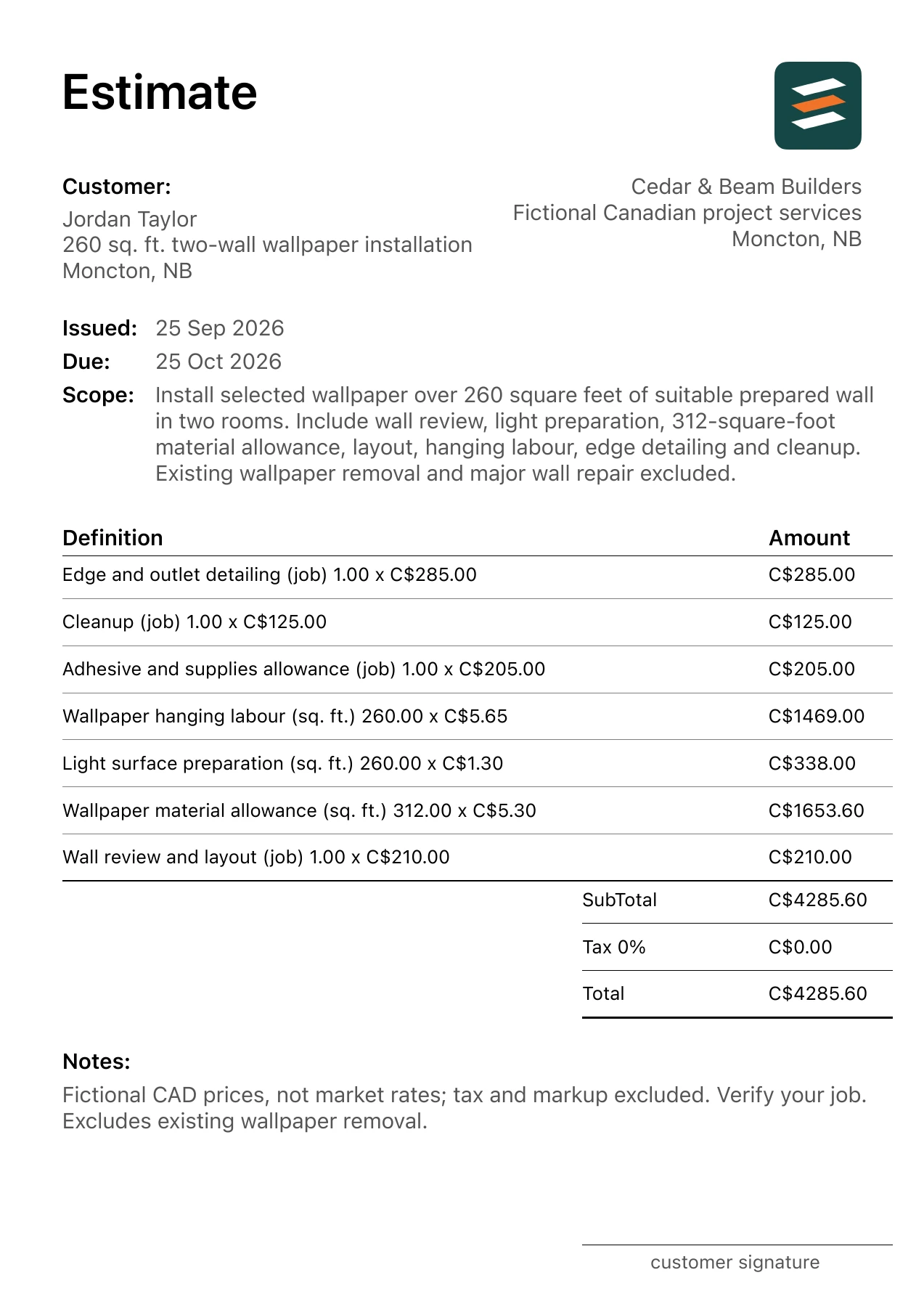
This guide follows a fictional 260 sq. ft. two-wall wallpaper installation in Moncton, New Brunswick. The linked wallpaper installation PDF example shows the scope and 7 separate costs in Canadian dollars. Treat it as a worked document, then use measurements, supplier quotes and labour inputs from your own project.
Cost of wallpapering: calculate strips before ordering rolls
A wallpapering estimate should record wall widths, usable heights, openings and the selected paper. Product roll length and width, pattern repeat and matching requirements determine purchasing. Dividing total wall area by roll area gives only a rough coverage check; it can underestimate rolls when the wall height or pattern leaves short unusable offcuts after each strip is cut.
Calculate the number of strips required for each wall, then determine usable strips per roll from the selected paper and layout. Have the supplier or decorator confirm the purchase quantity before ordering. Keep paper supply separate from hanging labour, existing covering removal and substrate preparation. Doors and windows do not always reduce effort in proportion to their area because edges and cuts remain.
Compare the cost of wallpapering using the same product, layout and wall condition. Record whether the decorator includes protection, moving furniture and disposal of removed covering. A damaged or unassessed substrate needs a defined preparation decision. State who keeps spare rolls and keep product details with the estimate; a later order of apparently similar paper should not be assumed to be the same selection or batch.
A separate worked planning example
Independent illustrative arithmetic: a hypothetical 4 m wall divided by a selected 0.5 m strip width requires 8 strips. If the user's product-and-pattern calculation allows 3 usable strips per roll, 8 ÷ 3 rounds up to 3 rolls. These dimensions are invented for arithmetic only. These hypothetical inputs are not market rates and do not replace the amounts in the linked PDF.
Cost and scope questions
Can wallpaper roll count be based on wall area alone?
Use area as a check, then calculate usable strips using wall height, roll dimensions and the selected pattern requirements. Confirm the layout with the supplier or decorator.
Does wallpapering cost include old-paper removal?
Only if stated. Removal, wall repair or preparation, product supply and hanging should have separate inclusions so quotes remain comparable.
1. Measure each wall
Record width, height, openings and stopping points. The 260-square-foot installed area does not directly determine roll count without product dimensions and pattern repeat.
2. Confirm the selected product
The 312-square-foot material allowance is illustrative. Recalculate actual rolls for the chosen paper, match and usable lengths before purchasing.
3. Check wall readiness
Smooth, sound walls are assumed. Old covering removal, skim coating or stain treatment should be inspected and priced separately.
4. Define detailing
Corners, outlets and trim junctions require layout and finish time. Include that work and cleanup so a square-foot hanging line does not hide every detail.
Review the Canadian project address
For the 260 sq. ft. two-wall wallpaper installation in Moncton, New Brunswick, the example uses the measured trade units shown in its PDF. Residential jobs may mix square feet, linear feet, counts and supplier units; keep each line’s measurement basis visible. Inspect substrate moisture and condition, product availability and the chosen finish. Write down the preparation level and any work needed before the selected product can be installed. The figures are fictional CAD inputs, not a local price survey.
Describe which products the customer supplies and which the contractor supplies. State how any site condition outside the visible scope will be assessed and priced. Do not copy an allowance from another city or assume a sample’s tax entry establishes the treatment for this client.
Work through the wallpaper installation quantities
The matching PDF lets the client check each extension of quantity and unit rate. For this example, two useful checks are:
- Light surface preparation: 260 sq. ft. × C$1.30 = C$338.00.
- Wallpaper material allowance: 312 sq. ft. × C$5.30 = C$1,653.60.
Adding all 7 lines gives a C$4,285.60 illustrative subtotal. The PDF records 0% tax and C$4,285.60 as its total, before any markup. These are chosen sample inputs, not prices observed in Moncton, New Brunswick. The measurement basis matters as much as the rate: a material purchase allowance may be larger than the installed area, while a fixture count is not interchangeable with hours of labour.
Check the scope before sending
- Measure wall heights and widths.
- Verify pattern repeat and roll yield.
- Inspect surface condition.
- List outlets, edges and removal work.
Outside the illustrated scope: No existing wallpaper removal, major plaster repair, furniture moving, wall painting or specialty mural alignment.
Check the business and client names, property location, dates, quantities, unit rates and notes. Confirm tax, markup and any required approvals for the actual job. If selections or site conditions are unresolved, label the line as an allowance and explain how it will be updated.
Common questions
Can I buy wallpaper from wall area alone?
No. Roll size, drop length and pattern repeat affect purchase quantity. Recalculate for the selected product.
Is old wallpaper removal included?
Only if listed. This example assumes suitable prepared walls.
Open the itemized wallpaper installation example and its app-exported PDF to see these decisions presented to a client. You can adapt the structure while replacing every fictional project input with your own.