THE SHORT ANSWER
Estimate plasterboard installation with separate quantities for board purchasing and finished surface area. Identify hanging, finishing, access and material handling, then describe the finish expected before painting.
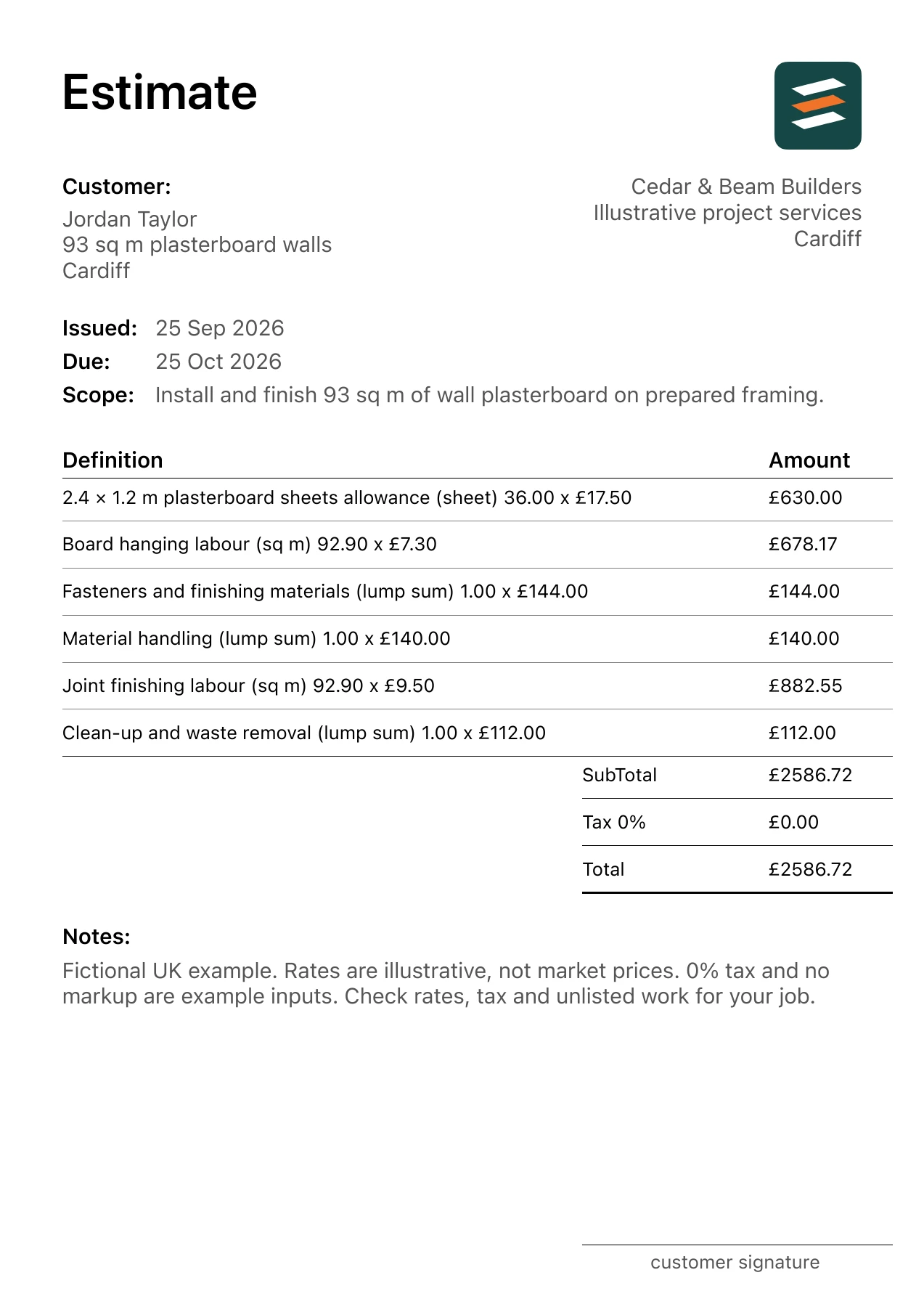
Use this fictional 93 sq m plasterboard wall installation in Cardiff to plan the estimate. The agreed work is: Install and finish 93 sq m of wall plasterboard on prepared framing. Allow 36 standard 2.4 × 1.2 m sheets for purchase, include fixing, joint finishing and clean-up. Ceiling work, insulation and painting are excluded. The matching plasterboard installation example and PDF shows the same inputs. These quantities and rates are teaching examples; use your own site measurements, product selections, supplier information and labour figures for a customer job.
1. Take off the surfaces to receive board
Measure wall lengths and heights and document openings. Treat ceilings separately if they are part of the job. Label the estimate’s area as board surface, not room floor area, so the measurement basis stays clear.
2. Convert area to a purchasing plan
A 2.4 × 1.2 metre plasterboard sheet covers 2.88 sq m before cuts. Ninety-three square metres therefore needs more than 32 complete sheets in pure area terms. The example allows 36 sheets for the layout; reconcile that with board type, delivery and the cutting plan.
3. Specify the finish scope
Hanging board and delivering a finished surface are separate stages. Identify joint treatment, corner details, sanding and any texture work included. Agree the required finish with the customer rather than leaving a vague promise of ready-to-go walls.
4. Check site readiness and handling
Confirm that framing is ready, materials can be brought inside and access remains available. Carrying sheets up stairs or protecting an occupied area may need explicit labour. Resolve those details before turning a preliminary takeoff into a firm scope.
Calculate the measured lines
The PDF uses 6 separate items. For example, 2.4 × 1.2 m plasterboard sheets allowance is 36 sheets × £17.50 = £630.00; Board hanging labour is 92.9 sq m × £7.30 = £678.17. Check that each unit describes the work being priced: area for a surface, metres for a run, and a count or defined lump sum for a discrete task. A material purchase allowance can differ from the installed quantity when product sizes, cuts or layout require it.
Adding the 6 rounded line amounts gives £2,586.72. The example PDF uses a 0% tax input and no markup; those settings do not determine how to price or treat an actual job. Do not copy the rates as a local price guide.
Check the scope before sending
- Distinguish purchased sheets from installed area.
- Identify walls and ceilings separately.
- Agree the required finishing scope.
- Confirm delivery, staging and waste responsibilities.
Outside the base scope: No framing correction, insulation, ceilings, painting, specialty assemblies or concealed service work.
Confirm the site address, selected products, access, quantities, customer details and validity date. If opening the work reveals a different condition, record the change and update the relevant line before asking the customer to approve the revised work. Preview every page of the PDF so the written scope, line amounts and total tell the same story.
Common questions
Should plasterboard sheets and labour use the same quantity?
Not necessarily. Purchasing is based on sheet layout and allowances; labour may use the measured installed surface. Explain both bases in the estimate.
Does plasterboard installation automatically include finishing?
Do not assume so. List hanging and finishing explicitly, even if you ultimately present them as a combined package.
FROM SITE NOTES TO AN ITEMISED PDF
Make your own plasterboard installation estimate.
Enter the scope in Estimates on iPhone or Android, edit each quantity and rate in pounds, add your business and customer details, and review the PDF before sharing it.