THE SHORT ANSWER
Estimate plasterboard repair by patch size, location, backing needs and finishing visits. Separate repairing the board from matching the final painted surface, and define what the customer should expect at handoff.
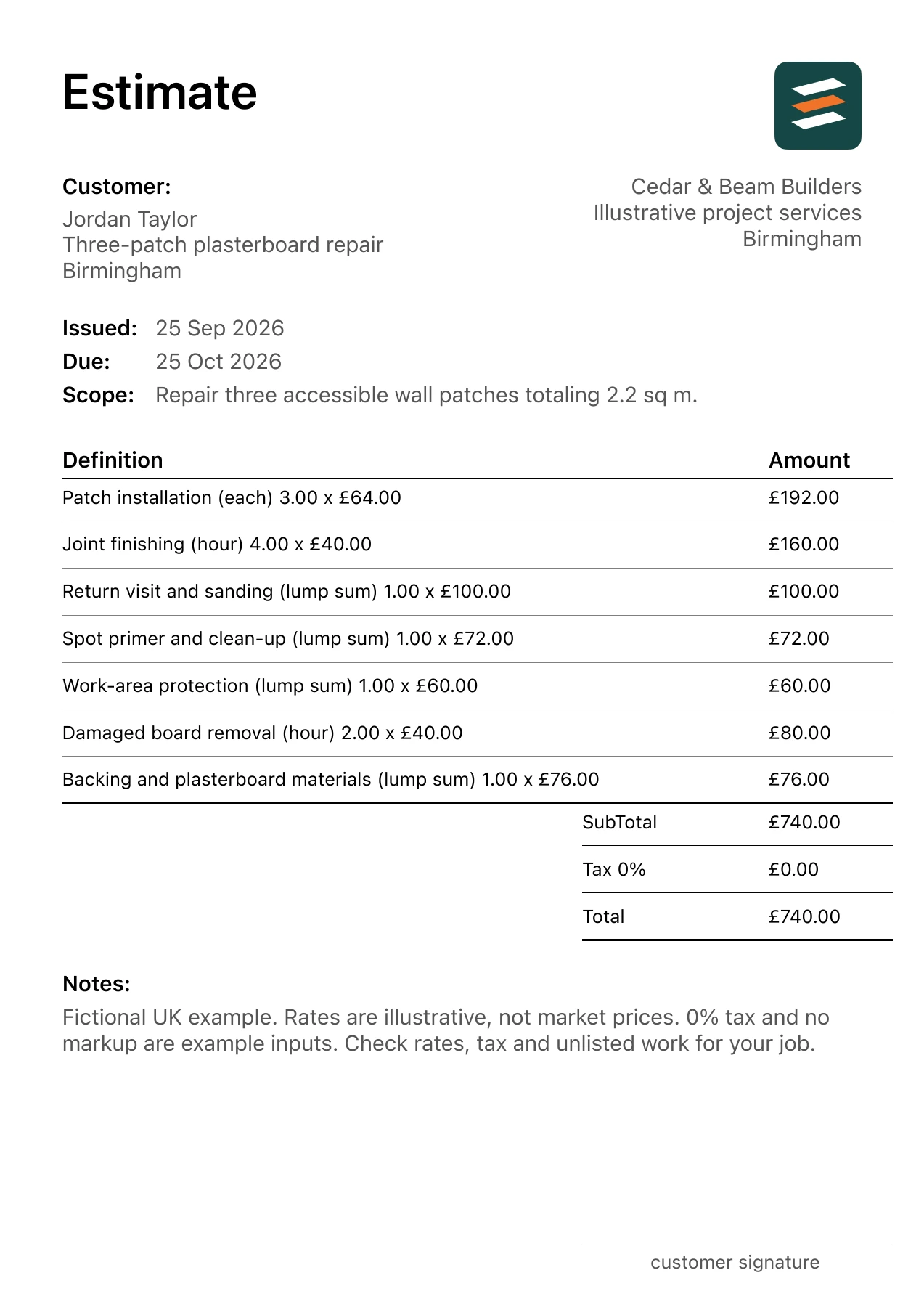
Use this fictional three-patch plasterboard repair in Birmingham to plan the estimate. The agreed work is: Repair three accessible wall patches totaling 2.2 sq m. Include protection, damaged-board removal, backing and board material, patch installation, joint finishing, a separate sanding visit and spot priming. Finish painting excluded. The matching plasterboard repair example and PDF shows the same inputs. These quantities and rates are teaching examples; use your own site measurements, product selections, supplier information and labour figures for a customer job.
plasterboard repair cost calculator: describe each patch
A plasterboard repair cost calculator needs a patch schedule, not just the total damaged area. Record each patch's approximate dimensions, wall or ceiling location, access and the surrounding finish. Several small isolated repairs can take different effort from one continuous repair of equal area. Photographs help define visible work, but they do not reveal all conditions behind the surface.
Separate assessment, material allowance, patch preparation and finishing, then identify whether primer and repainting are included. Ask what painted area the customer expects at handoff: the repaired patch, one full wall or a larger connected space. A repair-only rate should not be compared with a quote that includes full-wall decoration. Write the finish expectations before deciding on a unit price.
If staining, repeated cracking or movement suggests an unresolved cause, obtain an appropriate assessment and keep that investigation separate from cosmetic pricing. Do not describe a patch allowance as moisture or structural remediation. Explain the number of visits and the access assumptions in the estimate; a fixed preparation or attendance cost can be visible without being disguised as an unusually high area rate.
A separate worked planning example
Independent illustrative arithmetic: three hypothetical patches with a user-assumed £45.00 repair labour allowance each give £135.00. Adding an assumed £35.00 material line and £70.00 agreed painting line gives £240.00 for the stated scope. These hypothetical inputs are not market rates and do not replace the amounts in the linked PDF.
Cost and scope questions
Can repair cost be calculated per square foot?
Area can help describe a larger patch, but count, location, access, finish and attendance also affect the scope. State a minimum or fixed task allowance separately when used.
Does a patch repair quote include matching the paint?
Only if the painting area and expected finish are stated. Patch-only finishing and repainting a whole wall should have different, explicit scopes.
1. Count patches and record dimensions
Three small openings and one continuous repair can require different handling even when their total area is similar. Record patch dimensions, height and access. Note whether the edges provide suitable support or additional backing is included.
2. Distinguish cause from cosmetic repair
Repairing the visible board does not resolve a leak or movement that caused damage. State what must be resolved before the patching work starts. If the cause is outside your scope, make that dependency visible in the estimate.
3. Include the return work
Finishing, drying intervals, sanding and touch-up can require more than one visit. Rather than hiding all time in the board price, account for the expected visits and setup. The example includes a separate return-and-sanding line.
4. Define the finished condition
Paint-ready, spot-primed and fully repainted are different outcomes. Texture matching and full-wall painting may also be separate. Explain the base finish in plain language so a customer does not assume invisible colour blending is included.
Calculate the measured lines
The PDF uses 7 separate items. For example, Damaged board removal is 2 hours × £40.00 = £80.00; Patch installation is 3 each × £64.00 = £192.00. Check that each unit describes the work being priced: area for a surface, metres for a run, and a count or defined lump sum for a discrete task. A material purchase allowance can differ from the installed quantity when product sizes, cuts or layout require it.
Adding the 7 rounded line amounts gives £740.00. The example PDF uses a 0% tax input and no markup; those settings do not determine how to price or treat an actual job. Do not copy the rates as a local price guide.
Check the scope before sending
- Record patch dimensions and access height.
- Confirm the cause of damage has been addressed.
- List finishing and return visits.
- State whether texture and final painting are included.
Outside the base scope: No leak correction, concealed damage investigation, insulation replacement, finish painting or guaranteed texture/colour match.
Confirm the site address, selected products, access, quantities, customer details and validity date. If opening the work reveals a different condition, record the change and update the relevant line before asking the customer to approve the revised work. Preview every page of the PDF so the written scope, line amounts and total tell the same story.
Common questions
Should plasterboard repair include painting?
Only if the estimate explicitly includes it. State whether you deliver bare finished board, a spot-primed repair or a painted surface, and identify the painting area.
Why include a return-visit line?
Small repairs still involve setup, travel and finishing stages. A scoped return line makes that work understandable instead of suggesting all effort scales directly with patch area.
FROM SITE NOTES TO AN ITEMISED PDF
Make your own plasterboard repair estimate.
Enter the scope in Estimates on iPhone or Android, edit each quantity and rate in pounds, add your business and customer details, and review the PDF before sharing it.