THE SHORT ANSWER
Estimate roof space insulation from the area to be covered, target assembly confirmed for the property, material selection and access. Distinguish insulation from air sealing, removal and ventilation work.
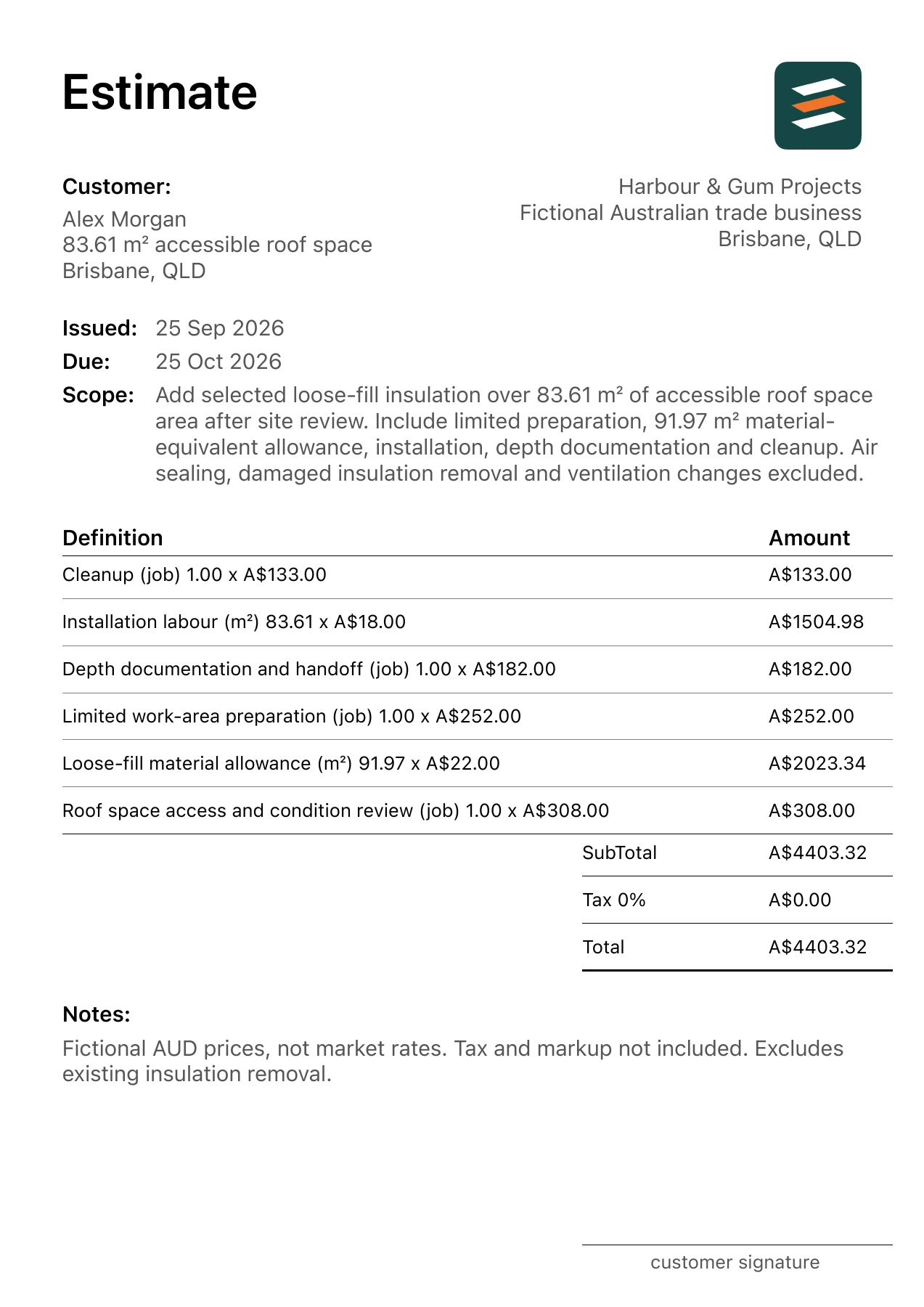
This Australian walkthrough uses a fictional 83.61 m² accessible roof space in Brisbane, Queensland. The matching roof space insulation estimate example shows the same item quantities and amounts in an app-exported PDF. Measure your own site and replace the example rates before issuing a client quote.
Attic insulation quantities: keep area separate from product coverage
An attic insulation estimate should record the accessible area, the existing insulation condition and the specialist's proposed upgrade. Measure the actual space to be treated rather than assuming it equals the total house floor area. Product selection and the intended performance target need project-specific review. A simple area calculation helps organise the quantity, but cannot decide whether the existing roof space is ready for insulation.
Keep site assessment, any agreed preparation, selected material, installation and documentation separate. Ask the supplier how the required product quantity follows from their stated coverage at the proposed specification. Loose-fill material quantities, rolls and boards cannot be compared using an unexplained pack count. Record restricted areas and obstructions so the quoted installation area and the purchase allowance are understandable and do not silently describe different spaces.
Moisture, roof leaks, air sealing and ventilation questions should be reviewed before assuming the work is simply adding material. Ask which recommended preparatory tasks are included and which need separate quotes. Compare offers on the same product and installation scope, and request written documentation of the supplied material and completed coverage. Do not treat a generic thickness or pack calculator as a recommendation for every property in Australia.
A separate worked planning example
Illustrative coverage calculation: 90 m² divided by a hypothetical supplier coverage of 3 m² per pack gives 30 packs before the supplier's stated ordering allowance. Coverage is an example input, not a product specification or required installation depth.
Cost and scope questions
Can I calculate insulation packs from floor area alone?
You also need the selected product's coverage at the proposed specification and the actual accessible treatment area. Confirm how the supplier handles obstructions and ordering allowances.
Does adding insulation include air sealing and ventilation work?
Only if named. Record the assessment and price any recommended air sealing, damaged-material removal or ventilation changes separately from a material top-up.
1. Measure the covered area
Use the accessible roof space footprint and identify excluded bays or storage zones. The 91.97 m² purchase-equivalent line is an example allowance, not an installed area.
For this example, the agreed starting scope is: Add selected loose-fill insulation over 83.61 m² of accessible roof space area after site review. Include limited preparation, 91.97 m² material-equivalent allowance, installation, depth documentation and cleanup. Air sealing, damaged insulation removal and ventilation changes excluded. A change to a listed surface, product or access assumption should trigger a revised line or allowance.
2. Review existing conditions
Document current material, moisture evidence, wiring and access constraints. Resolve any condition requiring another trade before pricing a straightforward addition.
3. Specify the selected material
Supplier coverage and intended installed depth govern actual ordering. Replace the fictional material rate and quantity with product data and a job-specific takeoff.
4. Separate related energy work
Air sealing and ventilation alterations are distinct scopes. State exactly whether either is included and how installed depth will be documented at handoff.
Worked roof space insulation calculation
Two checkable lines from the example are 91.97 m² × A$22.00 = A$2,023.34; 83.61 m² × A$18.00 = A$1,504.98. The full 6-line estimate totals A$4,403.32 with the demonstration tax input at 0%. The amount is a fictional scenario, not an Australian market rate or a recommended selling price.
Material purchasing and installed quantities may differ. For your own estimate, use the actual takeoff, supplier prices, labour plan, access and disposal requirements. Decide how overhead, profit and the applicable tax treatment affect your final quote; do not copy the example's zero tax setting.
Before you share the estimate
- Measure accessible coverage area.
- Review existing material and moisture conditions.
- Select product and target specification.
- Define air sealing and ventilation responsibilities.
Scope boundary in this example: No existing insulation removal, air sealing, ventilation alteration, moisture repair or hazardous-material handling.
Confirm the client details and location, item descriptions, measured units, total and validity date. If opening up the work reveals a different condition, document the changed scope and price before proceeding.
Common questions about roof space insulation
Is roof space area the same as house floor area?
Use the area actually receiving insulation. Measure or verify exclusions such as storage platforms and inaccessible sections.
Does insulation installation include air sealing?
Only if listed. This example treats it as a separate possible scope.
FROM SCOPE TO PDF
Make your own roof space insulation estimate.
Describe the actual job in Estimates on iPhone or Android, then review every quantity, rate and scope note. Add your business and client details, check the document and share an itemised PDF. Example amounts are fictional, and some app features may require an in-app purchase.