THE ESTIMATING ANSWER
For one existing vanity position, start with a defined scope and measurement basis. Measure cabinet width, depth, pipe entry points and floor clearance rather than relying on the old unit label. Separate the cabinet and top allowance from tapware, connection parts and installation labour. Price the listed tasks separately and state the condition that would require a revision: Unexpected pipe position or damaged wall behind the cabinet requires a revised connection or finish line.
This guide follows one existing vanity position in Melbourne, Victoria. The matching itemised estimate and PDF show how the job brief becomes measured quantities and separate AUD amounts. The responsible role in this scenario is renovation contractor. Check the actual site, selected products, supplier figures and labour plan before issuing a client quote.
Cost to remove a bathroom vanity: separate removal from replacement
The cost to remove a bathroom vanity is a narrower scope than replacing it with a fully connected new unit. Identify the existing cabinet, top and basin, whether they will be disposed of or retained, and who handles plumbing disconnection. Record access and any adjacent finish expected to remain. Avoid treating a cabinet count as a complete description of all removal work.
For replacement, add selected cabinet and top supply, basin and tap or faucet selections, assessed connection work and any agreed wall or floor finishing. Measure the space and pipe-entry positions rather than choosing a unit from the old cabinet's name alone. Qualified trade input should define connection changes; a product allowance cannot establish whether the existing arrangement suits the selected replacement.
Compare removal-only and replacement quotes by matching their handoff condition. State who removes packaging and the old unit, and whether decoration behind or around the vanity is included. Keep unexpected damage or incompatible connections as an explicit revision point after assessment. If only removal is requested, describe the safe trade handoff without implying that a disconnected bathroom is ready for normal use.
A separate worked planning example
Independent illustrative arithmetic: a hypothetical removal allowance of A$80.00 plus A$40.00 disposal gives A$120.00. Adding an invented A$500.00 replacement-unit allowance and A$160.00 assessed connection allowance gives A$780.00 for these lines, before other work. These hypothetical inputs are not market rates and do not replace the amounts in the linked PDF.
Cost and scope questions
Does the cost to remove a bathroom vanity include a plumber?
Only if the quoted scope explicitly includes assessed plumbing disconnection and the responsible trade. Ask how the plumbing handoff will be handled.
Can I compare a vanity removal price with a replacement total?
Separate removal, disposal, product supply, installation, connection work and finishing first. Their totals cover different work unless those inclusions match.
1. Define the measured job
Remove a single existing vanity, install a selected replacement in the same position, reconnect the existing services and finish exposed wall edges. Measure cabinet width, depth, pipe entry points and floor clearance rather than relying on the old unit label. Record the measurements and existing condition in the estimate before turning quantities into line items. The scope should make clear why this is a separate project from a broader renovation or maintenance quote.
Measure for this job: Measure cabinet width, depth, pipe entry points and floor clearance rather than relying on the old unit label. Put that measured basis beside the relevant PDF lines so area, fitted length and product purchase quantities stay distinct.
2. Build a product and labour schedule
Separate the cabinet and top allowance from tapware, connection parts and installation labour. This example has 7 distinct lines, including site measure and protection, existing vanity removal, vanity and top allowance. Use actual supplier prices and labour inputs for a customer job; the displayed amounts are fictional document inputs.
Choose before pricing: Separate the cabinet and top allowance from tapware, connection parts and installation labour. The fixture separates site measure and protection, existing vanity removal and vanity and top allowance rather than hiding all work in one figure.
3. Sequence the work and handoffs
Confirm product delivery and shutoff access before removing the existing unit. Show which task depends on access, a selected product or another trade. If that dependency is still open, label the price preliminary and identify the information needed before a firm quote.
Plan the handoffs: Confirm product delivery and shutoff access before removing the existing unit. Note which stage needs access, a selected product or another trade before the next stage can be priced confidently.
4. Set a change boundary
Unexpected pipe position or damaged wall behind the cabinet requires a revised connection or finish line. The example excludes plumbing relocation, new floor covering or concealed water-damage repair. Record the discovery, agree the revised work and update the estimate before adding it to the job.
Change trigger: Unexpected pipe position or damaged wall behind the cabinet requires a revised connection or finish line. Record the revised task and quantity before it changes the amount your client sees.
Review the Australian job
Verify the existing water and waste connections, access and selected fittings on site. Assign any specialist work and check approval requirements that apply to the actual address.
Count the actual products, site visits and specialist tasks separately. This fixture is a document example, not a substitute for inspecting the building. The amounts are fictional AUD inputs, not current prices for Melbourne, Victoria or another location.
Worked project calculation
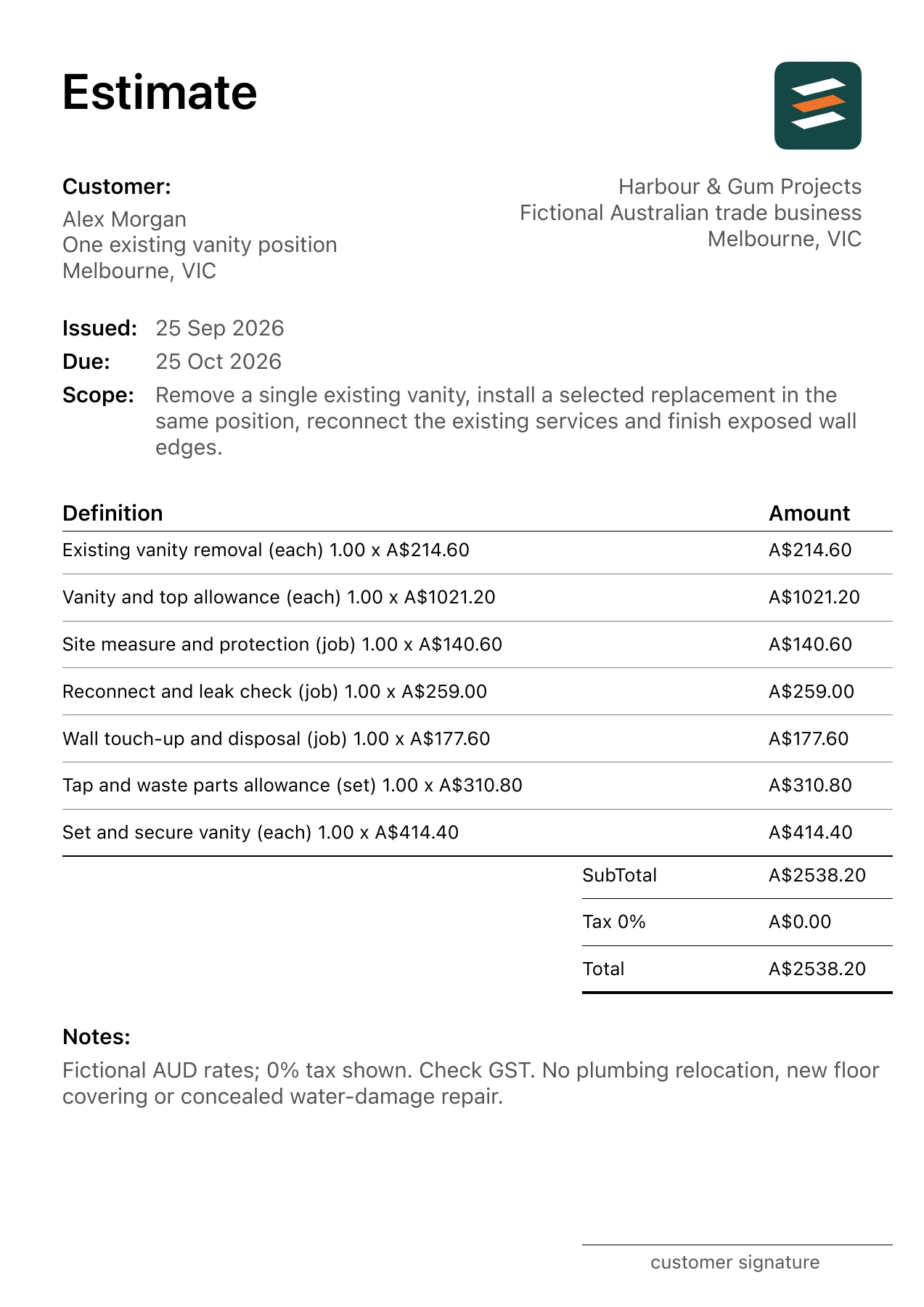
The paired PDF has 7 cost lines. For example, Existing vanity removal is 1 each × A$214.60 = A$214.60; Vanity and top allowance is 1 each × A$1,021.20 = A$1,021.20. Each amount comes from the stated quantity and unit rate, so you can trace the arithmetic back to the job scope.
| Work item | Quantity | Unit rate | Amount |
|---|---|---|---|
| Site measure and protection | 1 job | A$140.60 | A$140.60 |
| Existing vanity removal | 1 each | A$214.60 | A$214.60 |
| Vanity and top allowance | 1 each | A$1,021.20 | A$1,021.20 |
| Tap and waste parts allowance | 1 set | A$310.80 | A$310.80 |
| Set and secure vanity | 1 each | A$414.40 | A$414.40 |
| Reconnect and leak check | 1 job | A$259.00 | A$259.00 |
| Wall touch-up and disposal | 1 job | A$177.60 | A$177.60 |
| Illustrative total | A$2,538.20 | ||
Adding every exact-cent line gives A$2,538.20. The PDF uses a 0% tax input only to make its fictional arithmetic visible. Confirm the GST treatment that applies to the actual job and set your own markup before sharing a client quote. A fictional rate is a document input, not a market quote or a recommended selling price.
Scope and pricing boundaries
Remove a single existing vanity, install a selected replacement in the same position, reconnect the existing services and finish exposed wall edges.
Outside this example: No plumbing relocation, new floor covering or concealed water-damage repair.
Separate product allowances, supply, installation, disposal and any specialist work where the actual project needs them. If access or a hidden condition changes, document the affected scope and agree a revised price instead of silently extending the base amount.
Before you send the estimate
- Measure cabinet width, depth, pipe entry points and floor clearance rather than relying on the old unit label.
- Separate the cabinet and top allowance from tapware, connection parts and installation labour.
- Confirm product delivery and shutoff access before removing the existing unit.
- Unexpected pipe position or damaged wall behind the cabinet requires a revised connection or finish line.
Check business and client details, address, dates, scope, units, line amounts and PDF notes. The bathroom vanity unit replacement PDF example shows how this fictional project is presented. Its short PDF note is not a substitute for the detailed exclusions above.
Questions about this estimate
Which quantity controls this bathroom vanity replacement estimate?
Measure cabinet width, depth, pipe entry points and floor clearance rather than relying on the old unit label.
When should this bathroom vanity replacement quote be revised?
Unexpected pipe position or damaged wall behind the cabinet requires a revised connection or finish line. No plumbing relocation, new floor covering or concealed water-damage repair.
TURN THE SCOPE INTO AN ITEMISED PDF
Make your own bathroom vanity unit replacement estimate.
Describe the actual job in Estimates on iPhone or Android or use AI assistance to start a draft. Check every measurement, quantity, rate, allowance, client detail and note before exporting your PDF. Some app features may require an in-app purchase.