THE ESTIMATING ANSWER
For one residential charging point, start with a defined scope and measurement basis. Measure cable route, mounting position, panel capacity information and parking access before proposing equipment. Separate charger, cable and protective device allowances from installation labour. Price the listed tasks separately and state the condition that would require a revision: Insufficient capacity or a longer concealed route requires a revised design.
This guide follows one residential charging point in Sydney, New South Wales. The matching itemised estimate and PDF show how the job brief becomes measured quantities and separate AUD amounts. The responsible role in this scenario is electrical contractor. Check the actual site, selected products, supplier figures and labour plan before issuing a client quote.
1. Define the measured job
Install a selected home EV charger at a confirmed parking position with a defined cable route and existing-service assessment. Measure cable route, mounting position, panel capacity information and parking access before proposing equipment. Record the measurements and existing condition in the estimate before turning quantities into line items. The scope should make clear why this is a separate project from a broader renovation or maintenance quote.
Measure for this job: Measure cable route, mounting position, panel capacity information and parking access before proposing equipment. Put that measured basis beside the relevant PDF lines so area, fitted length and product purchase quantities stay distinct.
2. Build a product and labour schedule
Separate charger, cable and protective device allowances from installation labour. This example has 7 distinct lines, including site and load assessment allowance, charger unit allowance, cable and containment allowance. Use actual supplier prices and labour inputs for a customer job; the displayed amounts are fictional document inputs.
Choose before pricing: Separate charger, cable and protective device allowances from installation labour. The fixture separates site and load assessment allowance, charger unit allowance and cable and containment allowance rather than hiding all work in one figure.
3. Sequence the work and handoffs
A qualified installer must verify service and protective-device suitability before work. Show which task depends on access, a selected product or another trade. If that dependency is still open, label the price preliminary and identify the information needed before a firm quote.
Plan the handoffs: A qualified installer must verify service and protective-device suitability before work. Note which stage needs access, a selected product or another trade before the next stage can be priced confidently.
4. Set a change boundary
Insufficient capacity or a longer concealed route requires a revised design. The example excludes service upgrade, trench across public land or utility-provider work. Record the discovery, agree the revised work and update the estimate before adding it to the job.
Change trigger: Insufficient capacity or a longer concealed route requires a revised design. Record the revised task and quantity before it changes the amount your client sees.
Review the Australian job
Confirm the existing supply, route, mounting and testing with the qualified person responsible for this job. Check site-specific approval and inspection requirements before presenting a final price.
The cable and containment allowance line uses 19.81 m. Keep the site measurement and supplier's selling unit together; a material purchase allowance can differ from installed coverage. The amounts are fictional AUD inputs, not current prices for Sydney, New South Wales or another location.
Worked project calculation
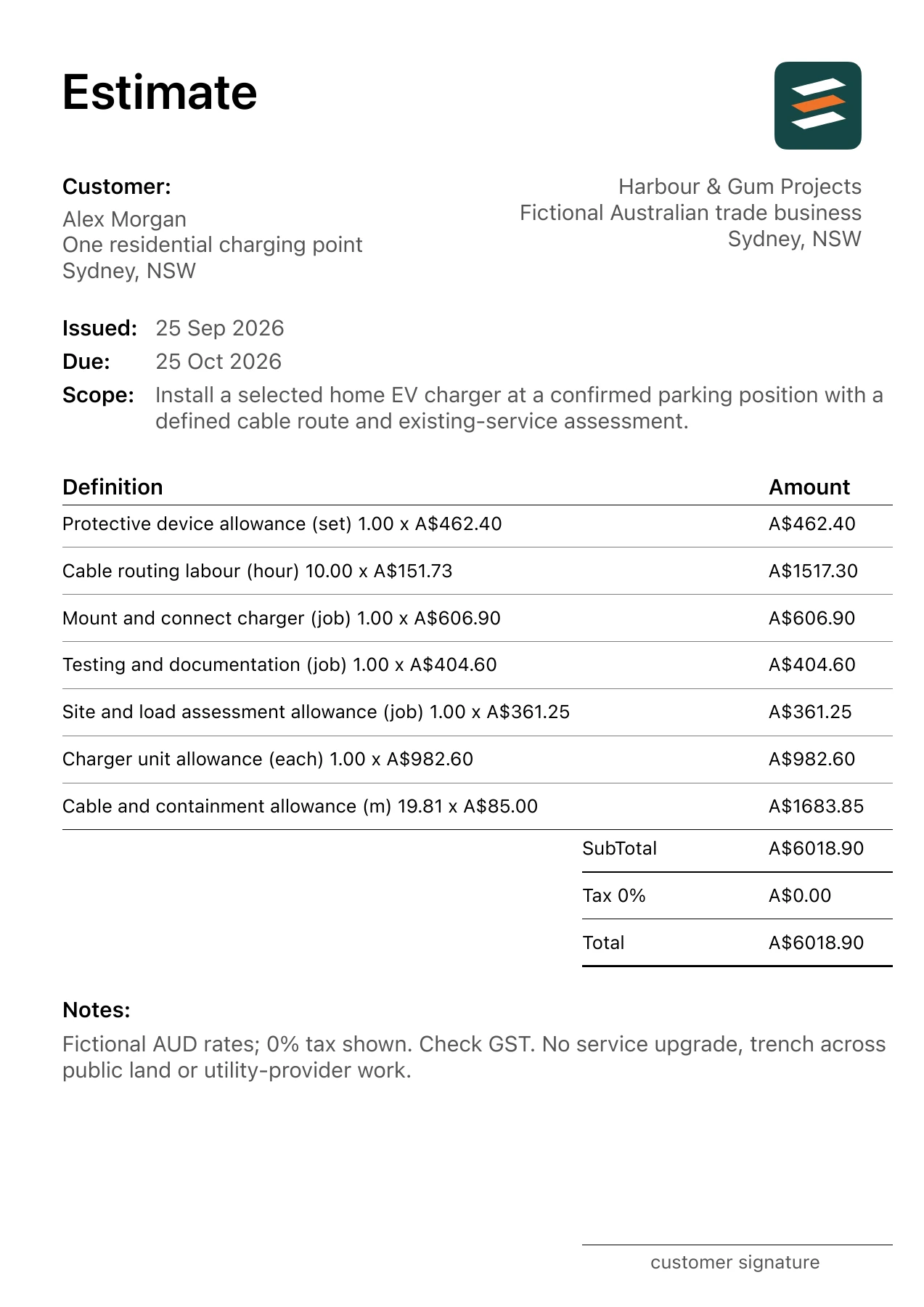
The paired PDF has 7 cost lines. For example, Charger unit allowance is 1 each × A$982.60 = A$982.60; Cable and containment allowance is 19.81 m × A$85.00 = A$1,683.85. Each amount comes from the stated quantity and unit rate, so you can trace the arithmetic back to the job scope.
| Work item | Quantity | Unit rate | Amount |
|---|---|---|---|
| Site and load assessment allowance | 1 job | A$361.25 | A$361.25 |
| Charger unit allowance | 1 each | A$982.60 | A$982.60 |
| Cable and containment allowance | 19.81 m | A$85.00 | A$1,683.85 |
| Protective device allowance | 1 set | A$462.40 | A$462.40 |
| Cable routing labour | 10 hours | A$151.73 | A$1,517.30 |
| Mount and connect charger | 1 job | A$606.90 | A$606.90 |
| Testing and documentation | 1 job | A$404.60 | A$404.60 |
| Illustrative total | A$6,018.90 | ||
Adding every exact-cent line gives A$6,018.90. The PDF uses a 0% tax input only to make its fictional arithmetic visible. Confirm the GST treatment that applies to the actual job and set your own markup before sharing a client quote. A fictional rate is a document input, not a market quote or a recommended selling price.
Scope and pricing boundaries
Install a selected home EV charger at a confirmed parking position with a defined cable route and existing-service assessment.
Outside this example: No service upgrade, trench across public land or utility-provider work.
Separate product allowances, supply, installation, disposal and any specialist work where the actual project needs them. If access or a hidden condition changes, document the affected scope and agree a revised price instead of silently extending the base amount.
Before you send the estimate
- Measure cable route, mounting position, panel capacity information and parking access before proposing equipment.
- Separate charger, cable and protective device allowances from installation labour.
- A qualified installer must verify service and protective-device suitability before work.
- Insufficient capacity or a longer concealed route requires a revised design.
Check business and client details, address, dates, scope, units, line amounts and PDF notes. The home EV charger installation PDF example shows how this fictional project is presented. Its short PDF note is not a substitute for the detailed exclusions above.
Questions about this estimate
Which quantity controls this home EV charger installation estimate?
Measure cable route, mounting position, panel capacity information and parking access before proposing equipment.
When should this home EV charger installation quote be revised?
Insufficient capacity or a longer concealed route requires a revised design. No service upgrade, trench across public land or utility-provider work.
TURN THE SCOPE INTO AN ITEMISED PDF
Make your own home EV charger installation estimate.
Describe the actual job in Estimates on iPhone or Android or use AI assistance to start a draft. Check every measurement, quantity, rate, allowance, client detail and note before exporting your PDF. Some app features may require an in-app purchase.