THE SHORT ANSWER
A handyman estimate should turn a vague task list into named tasks with quantities, material responsibilities and limits. Distinguish a fixed scope from time-based work so the customer understands how additional requests will be handled.
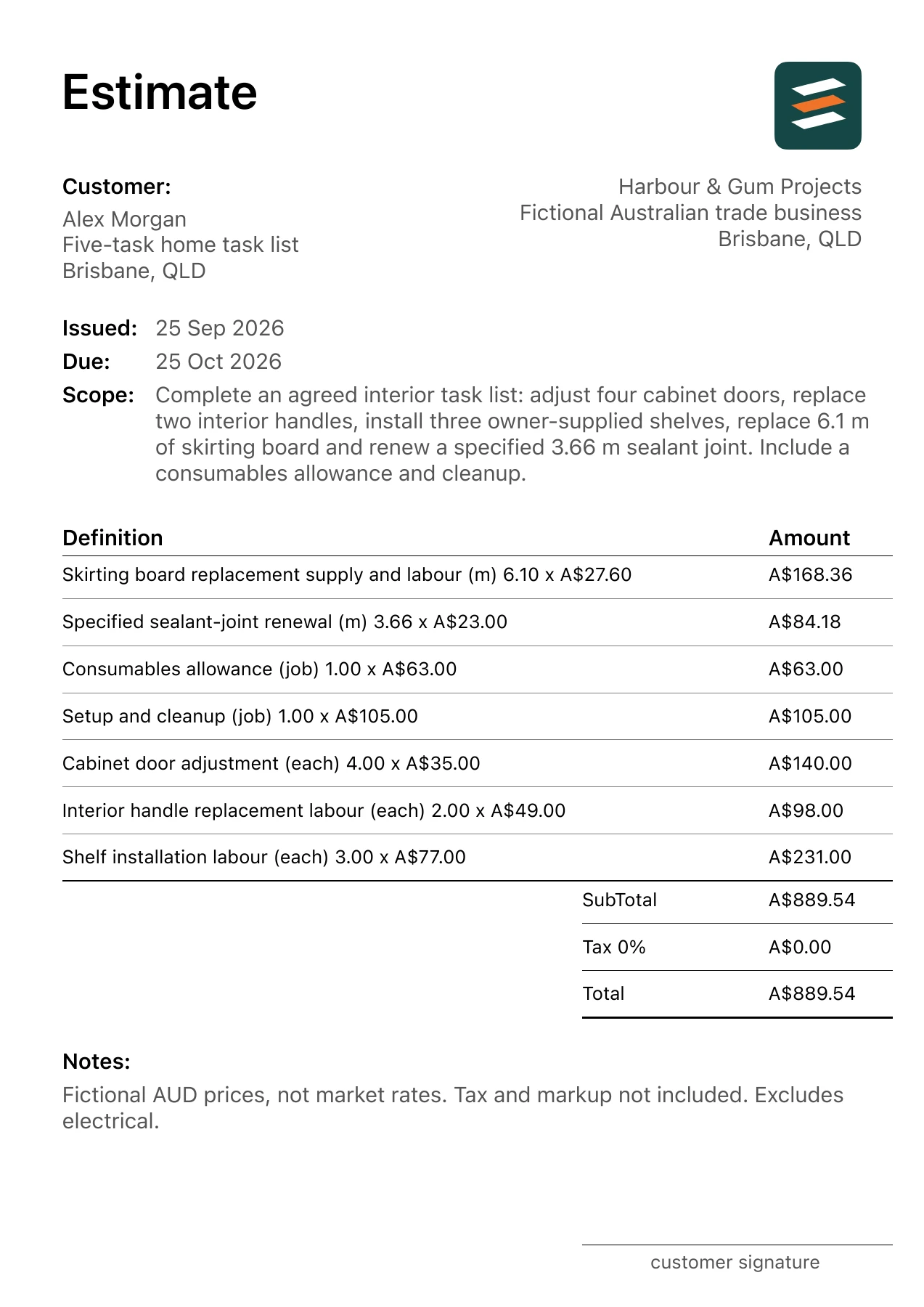
This Australian walkthrough uses a fictional five-task home task list in Brisbane, Queensland. The matching handyman task list estimate example shows the same item quantities and amounts in an app-exported PDF. Measure your own site and replace the example rates before issuing a client quote.
Handyman estimate: fixed tasks versus time-based work
A handyman estimate begins with a named task list. For each task, record the location, quantity, selected material and expected finish. Replacing a handle, adjusting a door and repairing a surface are different tasks even when requested on the same visit. Give the contractor photographs or site access where useful, but do not treat an unclear symptom as a fully diagnosed repair.
Choose a pricing basis for each agreed task: fixed scope, measured quantity or time-based work with stated assumptions. Show material supply separately and identify customer-supplied items. If using time-based work, explain the assumed hours, how additional time is agreed and whether attendance or travel has a separate line. Do not combine a fixed task price with duplicate labour hours for that same work.
Compare handyman quotes against one punch list and one handoff standard. New requests or discoveries should lead to a recorded change instead of being silently absorbed into the original task. Work needing qualified trade assessment or a specialist assembly specification should be identified separately. A clear estimate answers what will be completed during the visit and what information is still needed before the contractor can price it.
A separate worked planning example
Independent illustrative arithmetic: a hypothetical time-based visit of 3 hours at a user-supplied A$35.00 per hour gives A$105.00. Assumed materials of A$45.00 bring the stated visit to A$150.00, before any separately agreed attendance or extra tasks. These hypothetical inputs are not market rates and do not replace the amounts in the linked PDF.
Cost and scope questions
What should a handyman estimate include?
A task-by-task scope, quantities, supply responsibility, pricing basis, expected finish and a process for extra requests. Identify work awaiting diagnosis separately.
Should I use an hourly or fixed handyman estimate?
Choose the basis that matches the assessed task, and state it clearly. Fixed work needs a defined boundary; time-based work needs assumptions and an agreement process for extra time.
1. Convert requests into countable tasks
Replace general phrases such as fix the cabinets with the specific number of doors to adjust. Record location and expected outcome for each task. This reduces the chance that a short list expands into unrelated work during the visit.
For this example, the agreed starting scope is: Complete an agreed interior task list: adjust four cabinet doors, replace two interior handles, install three owner-supplied shelves, replace 6.1 m of skirting board and renew a specified 3.66 m sealant joint. Include a consumables allowance and cleanup. A change to a listed surface, product or access assumption should trigger a revised line or allowance.
2. Confirm supplied materials
Owner-supplied shelves or hardware still need to be available and suitable for the agreed task. Identify missing components and any purchase allowance. Do not combine a labour-only task with a material-inclusive task without labelling the difference.
3. Explain the pricing basis
If work is fixed-price, state the tasks and limits included. If you use hours, explain the approved scope and how extra time is discussed. This example prices tasks individually; it is not an open-ended commitment to complete any work requested that day.
4. Keep additions outside the original total
Ask the customer to review new tasks before they are added. Record the extra quantity, material and price in a revised estimate. A written scope change is easier to reconcile than an informal expectation that every small request was already included.
Worked handyman task list calculation
Two checkable lines from the example are 4 each × A$35.00 = A$140.00; 2 each × A$49.00 = A$98.00. The full 7-line estimate totals A$889.54 with the demonstration tax input at 0%. The amount is a fictional scenario, not an Australian market rate or a recommended selling price.
Material purchasing and installed quantities may differ. For your own estimate, use the actual takeoff, supplier prices, labour plan, access and disposal requirements. Decide how overhead, profit and the applicable tax treatment affect your final quote; do not copy the example's zero tax setting.
Before you share the estimate
- Name and count every task.
- Identify owner-supplied products.
- Explain fixed-price versus hourly assumptions.
- Agree how additional requests will be priced.
Scope boundary in this example: No electrical, plumbing or structural work; no concealed repairs or tasks beyond the listed quantities.
Confirm the client details and location, item descriptions, measured units, total and validity date. If opening up the work reveals a different condition, document the changed scope and price before proceeding.
Common questions about handyman task list
Should a handyman estimate list every small task?
List enough detail to establish the agreed scope, especially quantities and material responsibility. A grouped allowance is useful only when its limits are clear.
How do I handle extra requests during the visit?
Document the added task and its price or time basis, then obtain the customer’s agreement before treating it as part of the job.
FROM SCOPE TO PDF
Make your own handyman task list estimate.
Describe the actual job in Estimates on iPhone or Android, then review every quantity, rate and scope note. Add your business and client details, check the document and share an itemised PDF. Example amounts are fictional, and some app features may require an in-app purchase.