THE SHORT ANSWER
Write a window replacement estimate around a unit schedule with dimensions, product selections and installation assumptions. Separate product cost, labour and surrounding finish work, and explain how concealed opening damage will be handled.
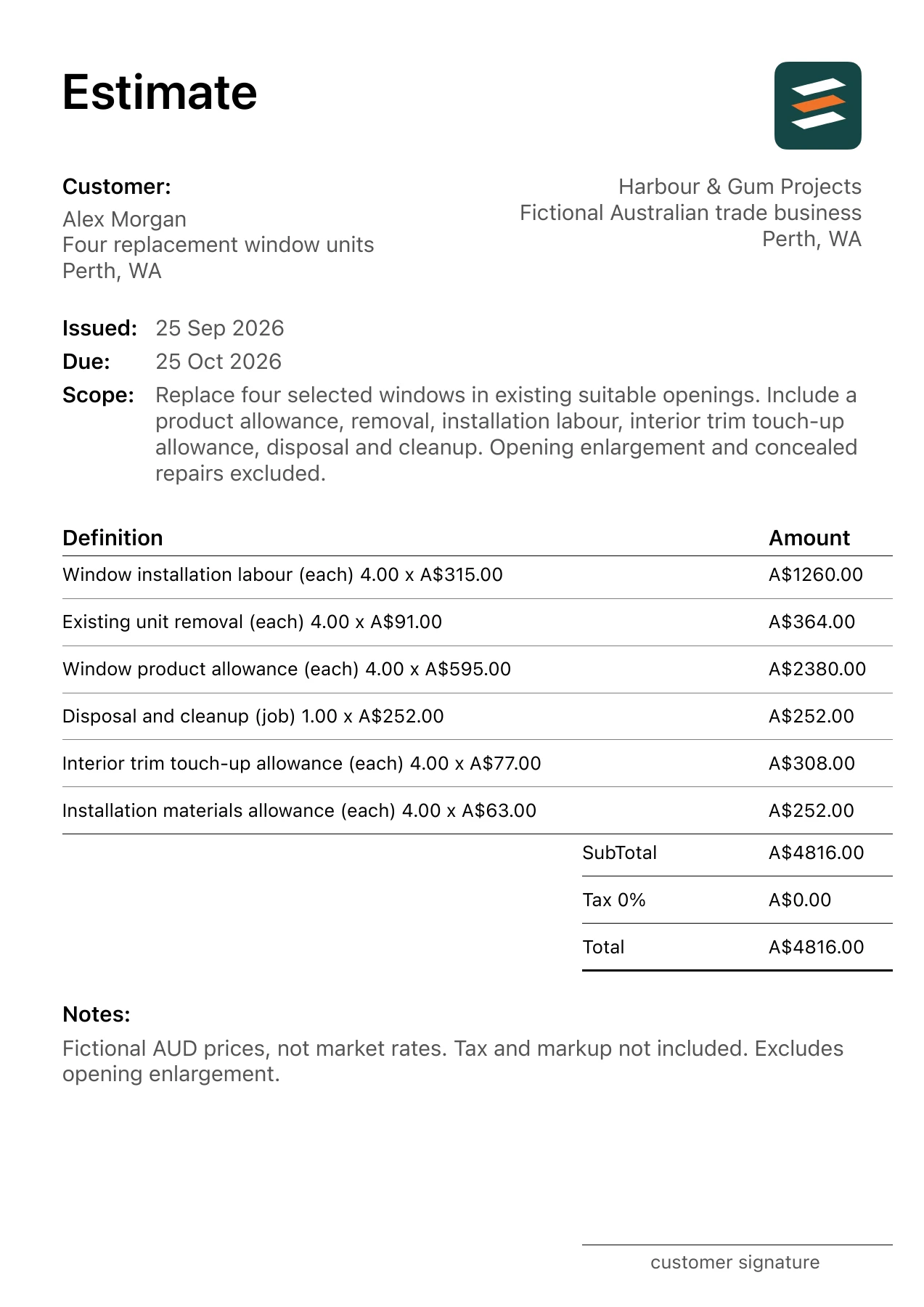
This Australian walkthrough uses a fictional four replacement window units in Perth, Western Australia. The matching window replacement estimate example shows the same item quantities and amounts in an app-exported PDF. Measure your own site and replace the example rates before issuing a client quote.
1. Create a unit schedule
Identify each window by room or location, dimensions and selected product. Quantity alone does not establish comparability. A customer can evaluate a quote more easily when four units refer to four specific openings.
For this example, the agreed starting scope is: Replace four selected windows in existing suitable openings. Include a product allowance, removal, installation labour, interior trim touch-up allowance, disposal and cleanup. Opening enlargement and concealed repairs excluded. A change to a listed surface, product or access assumption should trigger a revised line or allowance.
2. Clarify replacement assumptions
State the installation approach and starting condition determined for the actual property. The sample assumes suitable existing openings. It does not price enlargement, reframing or a redesign of the opening.
3. Account for surrounding finishes
Interior casing, exterior details and paint touch-up can differ from opening to opening. Describe the included finish work and who completes excluded tasks. A new window unit does not automatically mean every adjoining surface is refinished.
4. Handle product and condition changes explicitly
Replace the product allowance with a confirmed supplier quote once selections are settled. Explain the review process for concealed damage discovered during removal. Avoid promising product performance, energy savings or code compliance from a generic estimate example.
Worked window replacement calculation
Two checkable lines from the example are 4 each × A$595.00 = A$2,380.00; 4 each × A$91.00 = A$364.00. The full 6-line estimate totals A$4,816.00 with the demonstration tax input at 0%. The amount is a fictional scenario, not an Australian market rate or a recommended selling price.
Material purchasing and installed quantities may differ. For your own estimate, use the actual takeoff, supplier prices, labour plan, access and disposal requirements. Decide how overhead, profit and the applicable tax treatment affect your final quote; do not copy the example's zero tax setting.
Before you share the estimate
- List each opening and selected unit.
- Confirm dimensions before ordering.
- Define interior and exterior finish scope.
- Document concealed-condition and product-change handling.
Scope boundary in this example: No opening enlargement, structural repair, full wall refinishing, specialty glazing or performance guarantees beyond the selected product terms.
Confirm the client details and location, item descriptions, measured units, total and validity date. If opening up the work reveals a different condition, document the changed scope and price before proceeding.
Common questions about window replacement
Why separate window products from installation labour?
It shows how a different selected unit changes the material amount and keeps installation assumptions visible during comparisons.
Should trim be part of a window estimate?
State the agreed trim work explicitly. Include its quantity or allowance and distinguish touch-up from complete replacement or repainting.
FROM SCOPE TO PDF
Make your own window replacement estimate.
Describe the actual job in Estimates on iPhone or Android, then review every quantity, rate and scope note. Add your business and client details, check the document and share an itemised PDF. Example amounts are fictional, and some app features may require an in-app purchase.