THE SHORT ANSWER
Write a window replacement estimate around a unit schedule with dimensions, product selections and installation assumptions. Separate product cost, labour and surrounding finish work, and explain how concealed opening damage will be handled.
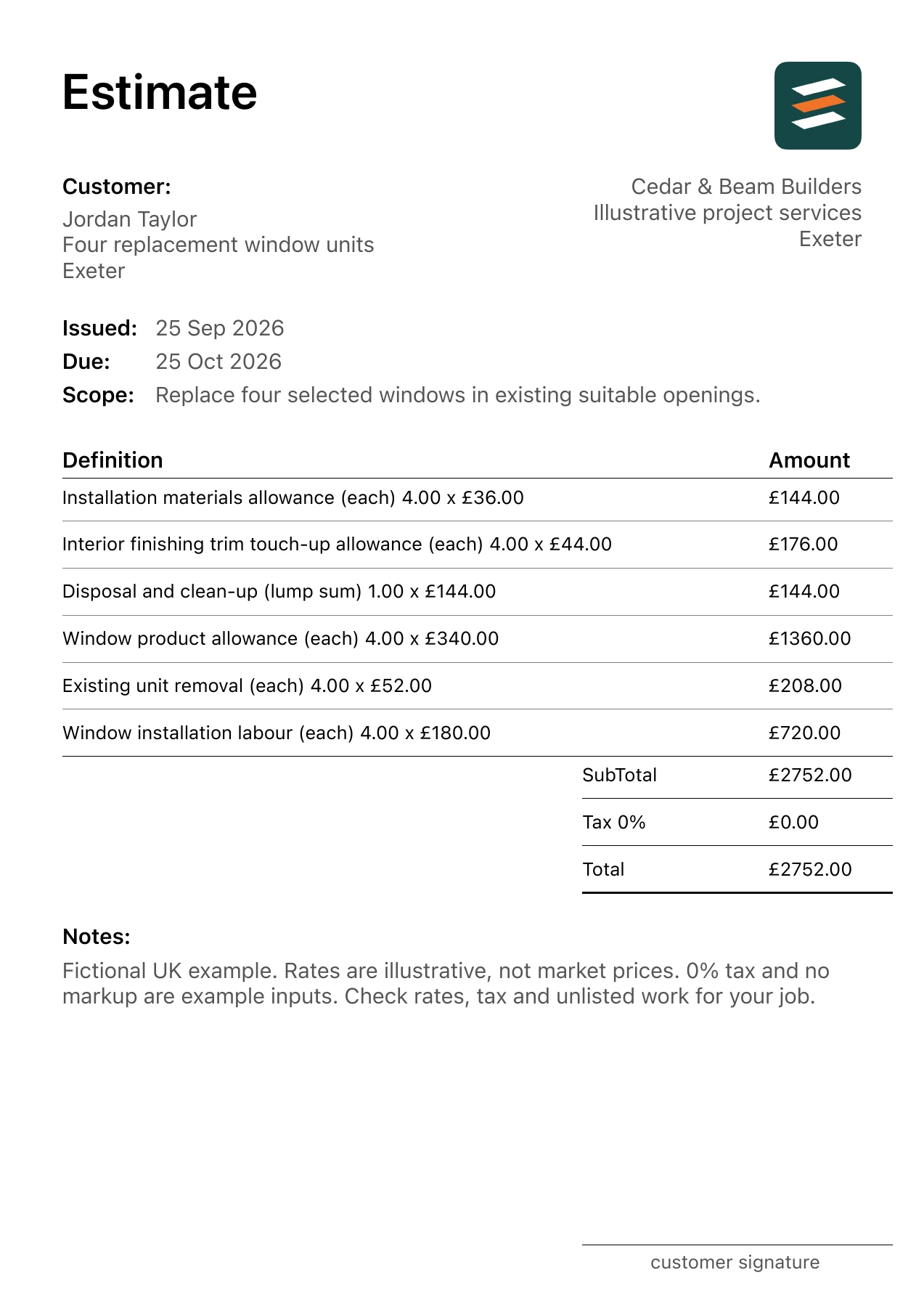
Use this fictional four replacement window units in Exeter to plan the estimate. The agreed work is: Replace four selected windows in existing suitable openings. Include a product allowance, removal, installation labour, interior finishing trim touch-up allowance, disposal and clean-up. Opening enlargement and concealed repairs excluded. The matching window replacement example and PDF shows the same inputs. These quantities and rates are teaching examples; use your own site measurements, product selections, supplier information and labour figures for a customer job.
Window replacement cost estimator: build a unit-by-unit schedule
A house window replacement cost estimator needs a schedule of actual units. Give each window an identifier, opening dimensions, product type, glazing selection and access note. Count units without merging different sizes into one average-window assumption. Replacement of a selected unit in a suitable opening and a change to opening size should be distinguished before product allowances are collected.
Separate window supply, removal, fitting, the specified closure scope and surrounding finish work. Ask the responsible specialist to assess the existing opening and record any limits to the base quote. Interior trim, exterior finishes and disposal can vary between proposals. Keep product identification visible so a change in glazing or frame selection does not quietly alter the comparison.
For a house window replacement calculation, request supplier and installer figures against the same schedule. A room count or floor-area input cannot show the number and specification of openings. Ask how access equipment, uncovered damage and delivery are included, and keep preliminary allowances identified until the actual openings and selected products have been assessed.
A separate worked planning example
Independent illustrative arithmetic: two identical hypothetical windows at £400.00 supply each give £800.00. Two fitting lines at £120.00 each add £240.00; assumed removal and finish costs of £100.00 make £1,140.00 for this limited schedule. These hypothetical inputs are not market rates and do not replace the amounts in the linked PDF.
Cost and scope questions
Can a window replacement cost calculator use a window count only?
A count can total identical specified units, but differing sizes, glazing, access and opening conditions need separate schedule entries.
Does window replacement include surrounding decoration?
Only where stated. Ask for interior trim, exterior finish and any wall repair to be included or excluded explicitly before comparing quotes.
1. Create a unit schedule
Identify each window by room or location, dimensions and selected product. Quantity alone does not establish comparability. A customer can evaluate a quote more easily when four units refer to four specific openings.
2. Clarify replacement assumptions
State the installation approach and starting condition determined for the actual property. The sample assumes suitable existing openings. It does not price enlargement, reframing or a redesign of the opening.
3. Account for surrounding finishes
Interior casing, exterior details and paint touch-up can differ from opening to opening. Describe the included finish work and who completes excluded tasks. A new window unit does not automatically mean every adjoining surface is refinished.
4. Handle product and condition changes explicitly
Replace the product allowance with a confirmed supplier quote once selections are settled. Explain the review process for concealed damage discovered during removal. Avoid promising product performance, energy savings or code compliance from a generic estimate example.
Calculate the measured lines
The PDF uses 6 separate items. For example, Window product allowance is 4 each × £340.00 = £1,360.00; Existing unit removal is 4 each × £52.00 = £208.00. Check that each unit describes the work being priced: area for a surface, metres for a run, and a count or defined lump sum for a discrete task. A material purchase allowance can differ from the installed quantity when product sizes, cuts or layout require it.
Adding the 6 rounded line amounts gives £2,752.00. The example PDF uses a 0% tax input and no markup; those settings do not determine how to price or treat an actual job. Do not copy the rates as a local price guide.
Check the scope before sending
- List each opening and selected unit.
- Confirm dimensions before ordering.
- Define interior and exterior finish scope.
- Document concealed-condition and product-change handling.
Outside the base scope: No opening enlargement, structural repair, full wall refinishing, specialty glazing or performance guarantees beyond the selected product terms.
Confirm the site address, selected products, access, quantities, customer details and validity date. If opening the work reveals a different condition, record the change and update the relevant line before asking the customer to approve the revised work. Preview every page of the PDF so the written scope, line amounts and total tell the same story.
Common questions
Why separate window products from installation labour?
It shows how a different selected unit changes the material amount and keeps installation assumptions visible during comparisons.
Should finishing trim be part of a window estimate?
State the agreed finishing trim work explicitly. Include its quantity or allowance and distinguish touch-up from complete replacement or repainting.
FROM SITE NOTES TO AN ITEMISED PDF
Make your own window replacement estimate.
Enter the scope in Estimates on iPhone or Android, edit each quantity and rate in pounds, add your business and customer details, and review the PDF before sharing it.