THE SHORT ANSWER
Estimate carpet with installed room area, purchasing quantity, pad, removal and transitions separated. Confirm roll layout and seams before treating a square-foot material allowance as final.
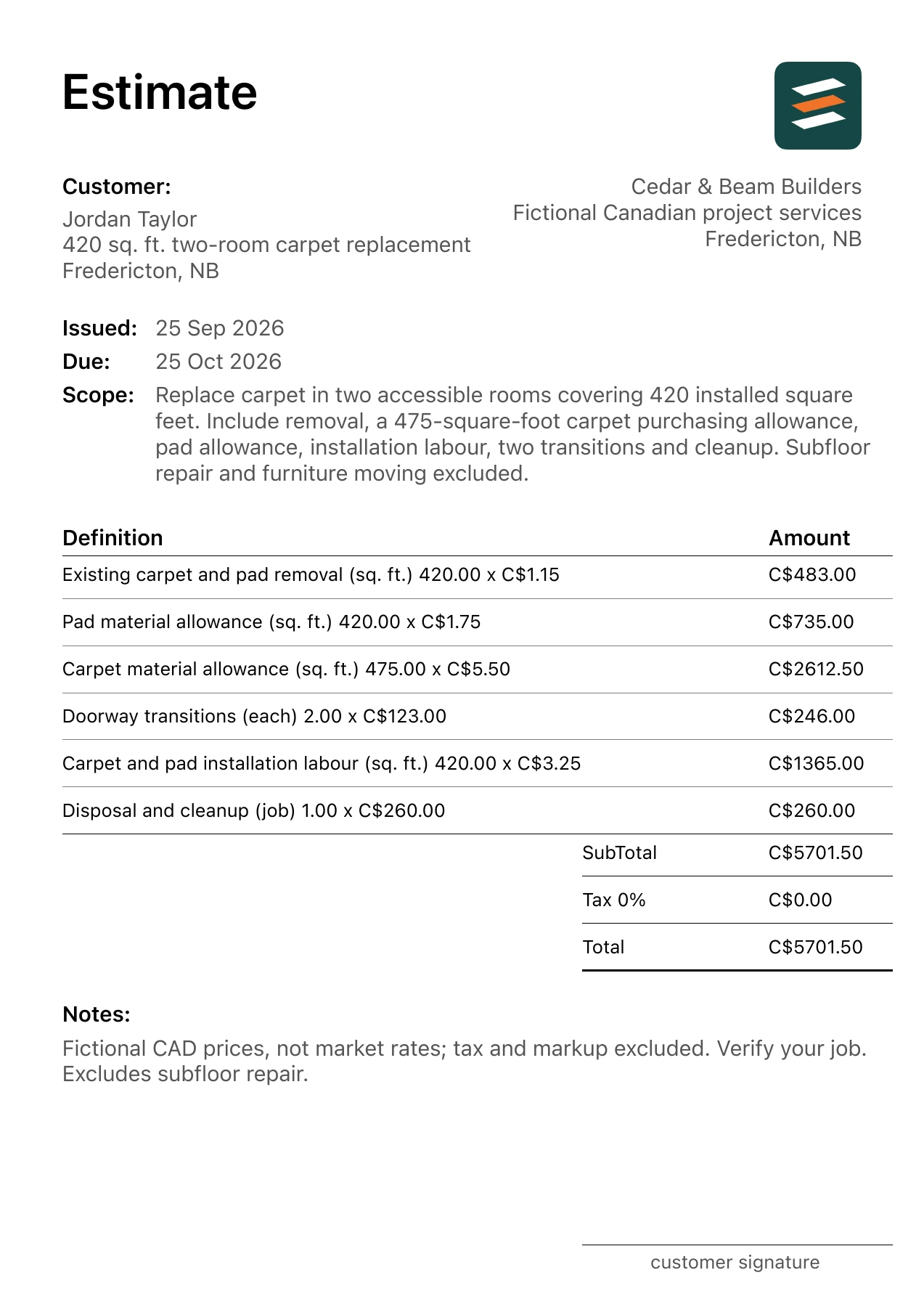
This guide follows a fictional 420 sq. ft. two-room carpet replacement in Fredericton, New Brunswick. The linked carpet installation PDF example shows the scope and 6 separate costs in Canadian dollars. Treat it as a worked document, then use measurements, supplier quotes and labour inputs from your own project.
Carpet replacement cost: separate installed area from carpet purchased
A carpet installation cost estimate needs two quantities: the floor actually covered and the carpet purchased for the agreed roll layout. Measure each room, including recesses, and record the supplier's roll width. Dividing a material quote by room area can produce a misleading installed rate when the quote includes offcuts, seams or a patterned product.
Build the replacement cost from carpet, underlay or pad, installation labour, old carpet removal, disposal, transitions and any agreed furniture handling. Ask whether the installer prices labour from the installed sq m or the purchased quantity. Keep stair work separate; a flight requires its own tread, riser and edge details rather than an allowance borrowed from a flat room.
For a useful carpet estimate, request the same product, room measurements and disposal scope from every bidder. State which subfloor conditions are already visible and which require a separate assessment after removal. Show the product allowance and its quantity before overhead and applicable tax, so a higher material purchase quantity is explainable without presenting it as additional installed floor.
A separate worked planning example
Independent illustrative arithmetic: 20 sq m of installation at a user-supplied C$30.00 per sq m is C$600.00. A separately chosen carpet purchase allowance of C$500.00 and removal allowance of C$100.00 give C$1,200.00 before any other lines. These hypothetical inputs are not market rates and do not replace the amounts in the linked PDF.
Cost and scope questions
How much does carpet and installation cost?
Calculate the selected carpet purchase quantity and agreed installation quantity separately, then add pad, removal and the other included tasks using actual supplier and contractor figures. A room-area-only calculation omits those decisions.
Does replacing carpet cost the same as laying carpet in an empty room?
Only if the included work is the same. Replacement may add removal, waste handling, furniture movement and assessment of the uncovered floor. Identify those lines before comparing totals.
1. Measure each room
Take dimensions and record closets, alcoves and doorways. Installed area is 420 square feet in this example, but roll layout can require a different purchase quantity.
2. Plan seams and material
The 475-square-foot allowance reflects a fictional layout, not a standard waste percentage. Confirm carpet width, pattern and seam placement for the selected product.
3. Identify pad and subfloor work
Pad is a distinct material line. This scope assumes a suitable subfloor and excludes repairs that appear after old carpet is removed.
4. Define transition and handling
Count threshold transitions and assign furniture movement, disposal and final cleanup so the total reflects the handoff expected by the customer.
Review the Canadian project address
For the 420 sq. ft. two-room carpet replacement in Fredericton, New Brunswick, the example uses the measured trade units shown in its PDF. Residential jobs may mix square feet, linear feet, counts and supplier units; keep each line’s measurement basis visible. Inspect substrate moisture and condition, product availability and the chosen finish. Write down the preparation level and any work needed before the selected product can be installed. The figures are fictional CAD inputs, not a local price survey.
Describe which products the customer supplies and which the contractor supplies. State how any site condition outside the visible scope will be assessed and priced. Do not copy an allowance from another city or assume a sample’s tax entry establishes the treatment for this client.
Work through the carpet installation quantities
The matching PDF lets the client check each extension of quantity and unit rate. For this example, two useful checks are:
- Existing carpet and pad removal: 420 sq. ft. × C$1.15 = C$483.00.
- Carpet material allowance: 475 sq. ft. × C$5.50 = C$2,612.50.
Adding all 6 lines gives a C$5,701.50 illustrative subtotal. The PDF records 0% tax and C$5,701.50 as its total, before any markup. These are chosen sample inputs, not prices observed in Fredericton, New Brunswick. The measurement basis matters as much as the rate: a material purchase allowance may be larger than the installed area, while a fixture count is not interchangeable with hours of labour.
Check the scope before sending
- Measure rooms and closets.
- Verify roll width and seam plan.
- Select carpet and pad.
- Count transitions and assign furniture moving.
Outside the illustrated scope: No subfloor repair, furniture moving, stair carpeting, specialty pattern matching or floor leveling.
Check the business and client names, property location, dates, quantities, unit rates and notes. Confirm tax, markup and any required approvals for the actual job. If selections or site conditions are unresolved, label the line as an allowance and explain how it will be updated.
Common questions
Why is purchase area above room area?
Carpet roll layout and seams can require more material than installed area. Verify the actual takeoff for the chosen product.
Is pad included in carpet material?
Not in this example. It has a separate allowance so product choices and quantities remain clear.
Open the itemized carpet installation example and its app-exported PDF to see these decisions presented to a client. You can adapt the structure while replacing every fictional project input with your own.