THE SHORT ANSWER
Estimate a fence from a verified alignment, height, material system and gate count. Use length to organize the job, but check posts, rails, pickets, corners and gates rather than relying on one unexplained per-foot price.
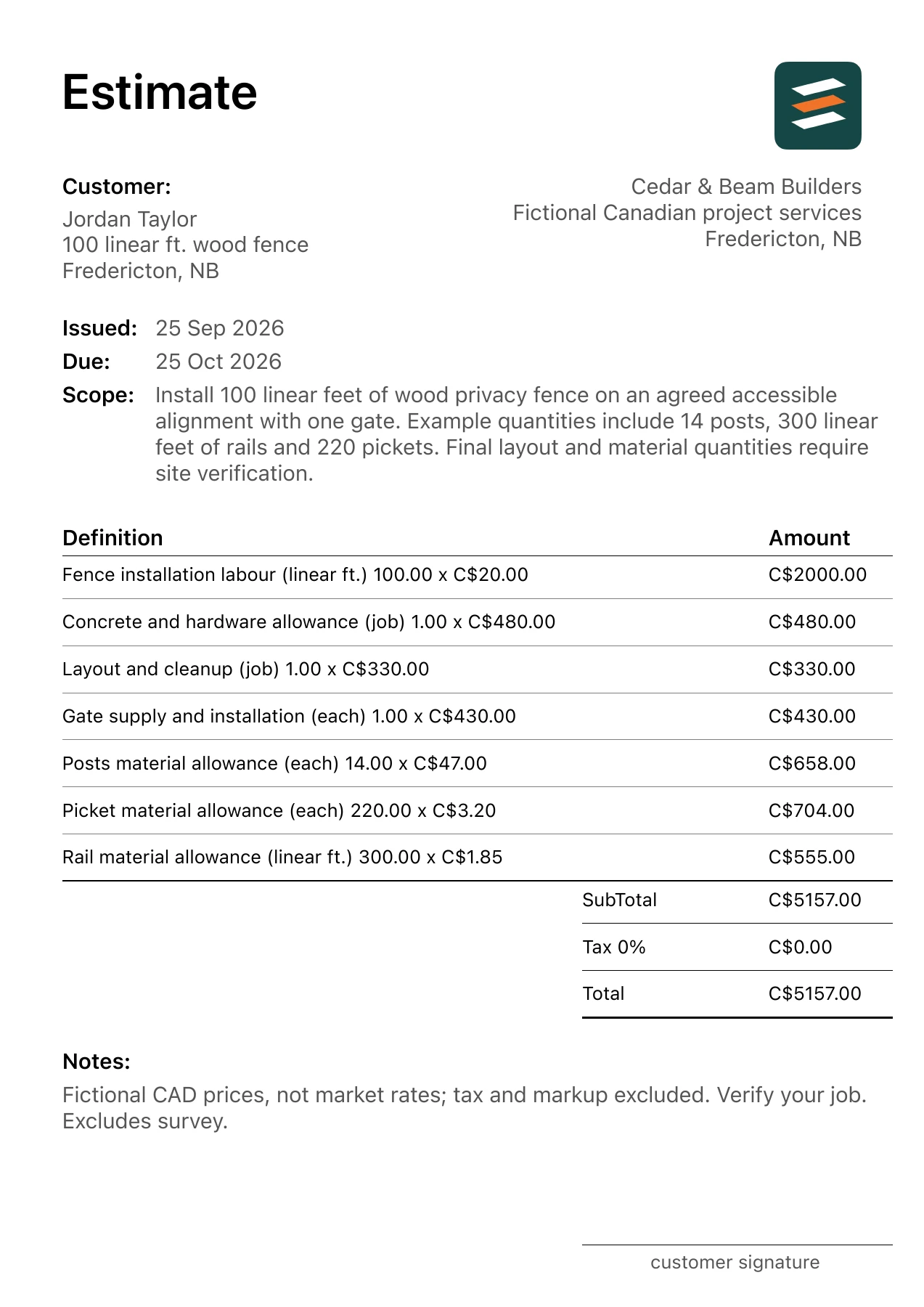
This guide follows a fictional 100 linear ft. wood fence in Fredericton, New Brunswick. The linked fence installation PDF example shows the scope and 7 separate costs in Canadian dollars. Treat it as a worked document, then use measurements, supplier quotes and labour inputs from your own project.
1. Agree the alignment and dimensions
Record the proposed run and height before preparing quantities. Identify corners, ends and changes in elevation. The estimate should say who confirms the boundary and access permissions; a drawing used for estimating is not a property survey.
2. Reconcile component quantities
This sample uses 14 posts and one gate, but real quantities follow the actual layout. Review rail lengths, picket spacing and hardware against the agreed system. Avoid copying the example count into a different fence without a takeoff.
3. Give gates their own line
A gate changes hardware, labour and adjoining components. Record the opening size, direction and latch expectations. Separate pricing makes it easier for a customer to compare a base run with an optional additional gate.
4. Record site assumptions
Existing-fence removal, difficult digging, access restrictions and disposal can change the scope. Identify these before setting the base amount. Address required utility-location and local-approval steps through the appropriate local process before ground disturbance.
Review the Canadian project address
For the 100 linear ft. wood fence in Fredericton, New Brunswick, the example uses the measured trade units shown in its PDF. Residential jobs may mix square feet, linear feet, counts and supplier units; keep each line’s measurement basis visible. Check access, grades, drainage and seasonal site conditions. Confirm any property-line, utility, design or municipal requirements that apply before committing to the work. The figures are fictional CAD inputs, not a local price survey.
Describe which products the customer supplies and which the contractor supplies. State how any site condition outside the visible scope will be assessed and priced. Do not copy an allowance from another city or assume a sample’s tax entry establishes the treatment for this client.
Work through the fence installation quantities
The matching PDF lets the client check each extension of quantity and unit rate. For this example, two useful checks are:
- Posts material allowance: 14 each × C$47.00 = C$658.00.
- Rail material allowance: 300 linear ft. × C$1.85 = C$555.00.
Adding all 7 lines gives a C$5,157.00 illustrative subtotal. The PDF records 0% tax and C$5,157.00 as its total, before any markup. These are chosen sample inputs, not prices observed in Fredericton, New Brunswick. The measurement basis matters as much as the rate: a material purchase allowance may be larger than the installed area, while a fixture count is not interchangeable with hours of labour.
Check the scope before sending
- Confirm alignment, height and access.
- Count posts, corners, rails and gates.
- State removal and disposal responsibilities.
- Verify relevant site and approval prerequisites before work.
Outside the illustrated scope: No survey, old-fence removal, rock excavation, retaining structures, staining or automatic gate equipment.
Check the business and client names, property location, dates, quantities, unit rates and notes. Confirm tax, markup and any required approvals for the actual job. If selections or site conditions are unresolved, label the line as an allowance and explain how it will be updated.
Common questions
Is fence length enough for a complete estimate?
No. It is a starting measurement. Gates, corners, height, components, terrain and removal requirements can change the scope and should be identified.
How should I show an optional second gate?
Keep it outside the accepted base total as a clearly labeled option, or issue a revised estimate once the customer selects it.
Open the itemized fence installation example and its app-exported PDF to see these decisions presented to a client. You can adapt the structure while replacing every fictional project input with your own.