THE SHORT ANSWER
Estimate fixture installation by fixture count, mounting requirements and existing box condition. State whether the customer supplies the fixtures and whether old-unit disposal is included.
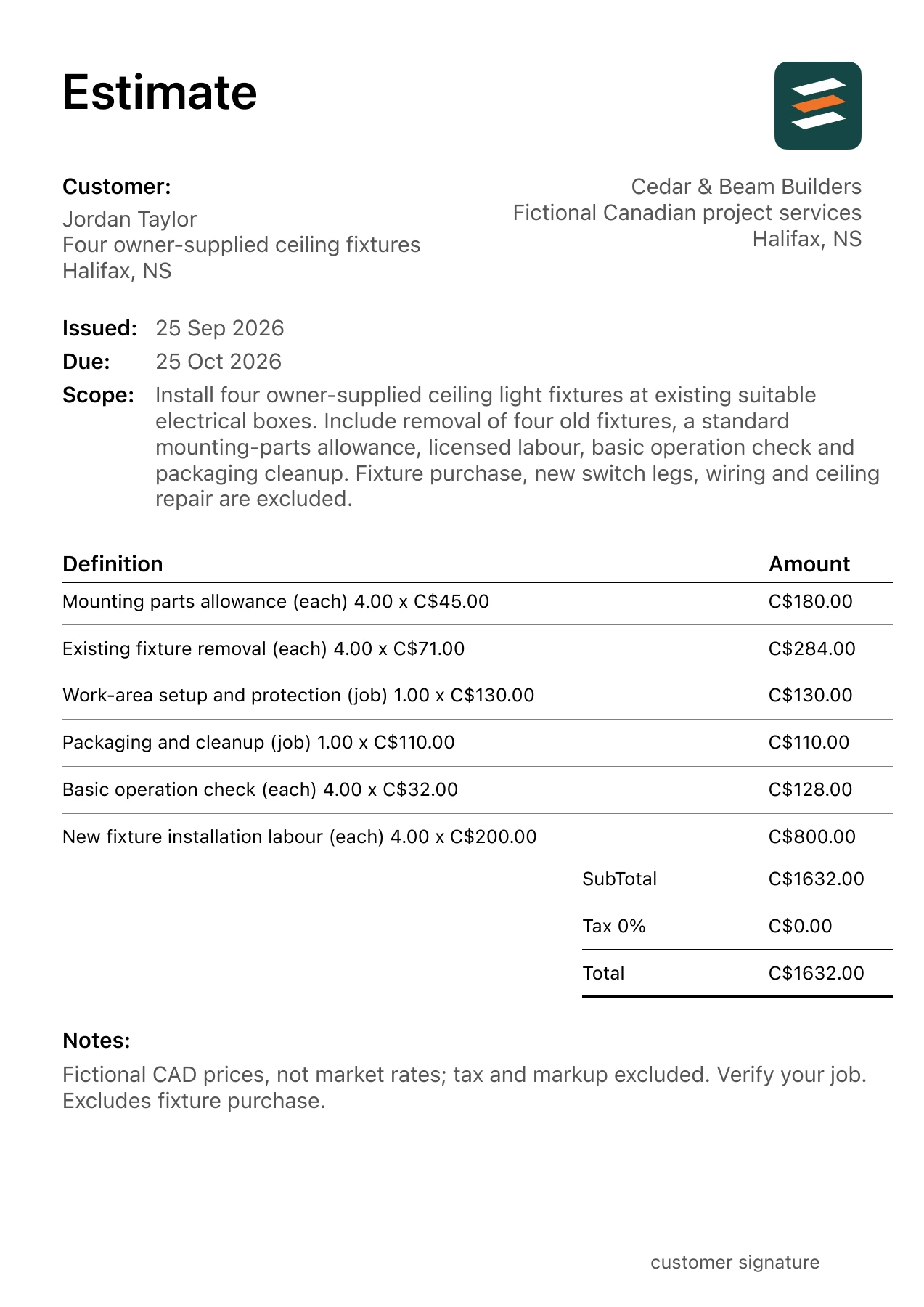
This guide follows a fictional four owner-supplied ceiling fixtures in Halifax, Nova Scotia. The linked light fixture installation PDF example shows the scope and 6 separate costs in Canadian dollars. Treat it as a worked document, then use measurements, supplier quotes and labour inputs from your own project.
1. List the fixtures by location
Record selected model, ceiling height and mounting detail. A pendant, flush mount and heavy specialty fixture should not be silently treated as the same work.
2. Confirm the mounting basis
The sample assumes suitable existing boxes and controls. Any box reinforcement, circuit change or wall/ceiling finish work requires separate review.
3. Define supply and handling
Owner-supplied fixtures still require receipt, inspection for missing parts and assembly time. Assign those tasks clearly to avoid ambiguity at installation.
4. Close out each location
Include a basic operation check and identify who handles packaging and removed fixtures. Verify any applicable permit and qualified-trade requirements for the property.
Review the Canadian project address
For the four owner-supplied ceiling fixtures in Halifax, Nova Scotia, the example uses the measured trade units shown in its PDF. Residential jobs may mix square feet, linear feet, counts and supplier units; keep each line’s measurement basis visible. Confirm the existing wiring, mounting and access with the person doing the work. Check which approvals or inspections apply at the project address before the estimate is treated as final. The figures are fictional CAD inputs, not a local price survey.
Describe which products the customer supplies and which the contractor supplies. State how any site condition outside the visible scope will be assessed and priced. Do not copy an allowance from another city or assume a sample’s tax entry establishes the treatment for this client.
Work through the light fixture installation quantities
The matching PDF lets the client check each extension of quantity and unit rate. For this example, two useful checks are:
- Existing fixture removal: 4 each × C$71.00 = C$284.00.
- Mounting parts allowance: 4 each × C$45.00 = C$180.00.
Adding all 6 lines gives a C$1,632.00 illustrative subtotal. The PDF records 0% tax and C$1,632.00 as its total, before any markup. These are chosen sample inputs, not prices observed in Halifax, Nova Scotia. The measurement basis matters as much as the rate: a material purchase allowance may be larger than the installed area, while a fixture count is not interchangeable with hours of labour.
Check the scope before sending
- Record model and location for each fixture.
- Verify box and ceiling-height assumptions.
- Assign product and old-fixture handling.
- Confirm qualified-trade and approval requirements.
Outside the illustrated scope: No fixture purchase, new wiring, switch relocation, box reinforcement, ceiling refinishing or specialty lift access.
Check the business and client names, property location, dates, quantities, unit rates and notes. Confirm tax, markup and any required approvals for the actual job. If selections or site conditions are unresolved, label the line as an allowance and explain how it will be updated.
Common questions
Does a light installation estimate include the fixtures?
This example is for owner-selected fixtures; no fixture purchase is listed. Add a product allowance when the contractor supplies them.
Should old fixtures be removed in a separate line?
Yes when removal is part of the work. It makes handling and disposal responsibilities easier to see.
Open the itemized light fixture installation example and its app-exported PDF to see these decisions presented to a client. You can adapt the structure while replacing every fictional project input with your own.