THE SHORT ANSWER
Write a deck repair estimate around identified components and repair limits. Count the boards or rail sections to be replaced, state the supporting-structure assumption, and keep a repair quote distinct from a full deck rebuild.
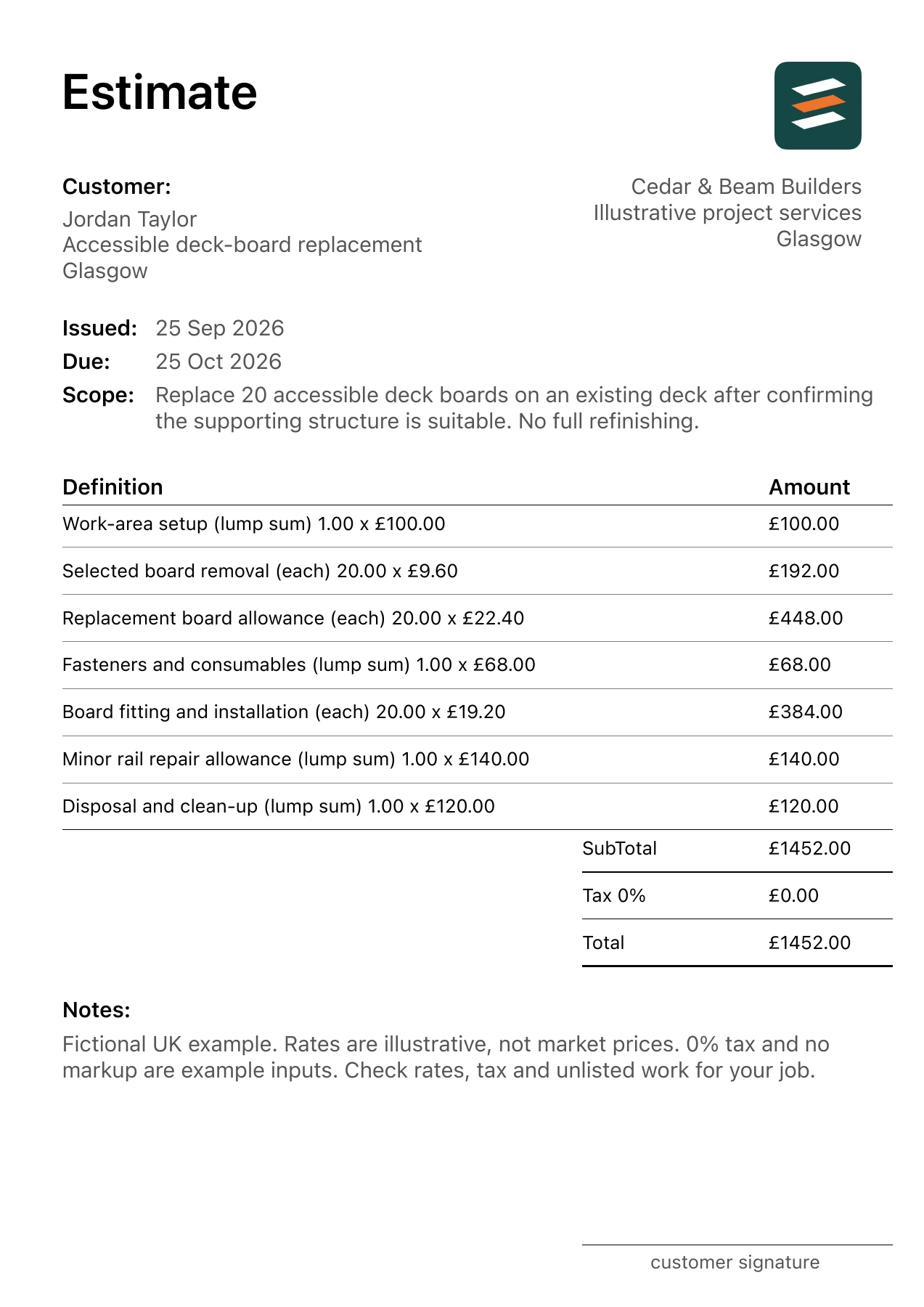
Use this fictional accessible deck-board replacement in Glasgow to plan the estimate. The agreed work is: Replace 20 accessible deck boards on an existing deck after confirming the supporting structure is suitable. Include removal, replacement-board and fastener allowance, fitting, a small rail repair allowance and waste disposal. No full refinishing. The matching decking repair example and PDF shows the same inputs. These quantities and rates are teaching examples; use your own site measurements, product selections, supplier information and labour figures for a customer job.
1. Identify the specific components
Mark the boards and rail sections included in the estimate and record their dimensions. A count of 20 boards is useful only if everyone knows which boards and what replacement size is assumed. Photos can support your internal takeoff.
2. Separate inspection from the priced repair
Visible surface damage may not describe the condition underneath. The example assumes the supporting structure has already been found suitable. If that has not been established, explain what must be checked before confirming the repair scope.
3. Define material matching expectations
New boards may differ in appearance from existing ones. Record the replacement material and whether staining or full refinishing is included. Do not let a small replacement allowance imply that the entire deck will look newly built.
4. Show removal, installation and disposal
Breaking out those tasks makes changes easier to price if the final board count differs. Specify the process for additional damage discovered during removal, including review of the revised quantity before proceeding.
Calculate the measured lines
The PDF uses 7 separate items. For example, Selected board removal is 20 each × £9.60 = £192.00; Replacement board allowance is 20 each × £22.40 = £448.00. Check that each unit describes the work being priced: area for a surface, metres for a run, and a count or defined lump sum for a discrete task. A material purchase allowance can differ from the installed quantity when product sizes, cuts or layout require it.
Adding the 7 rounded line amounts gives £1,452.00. The example PDF uses a 0% tax input and no markup; those settings do not determine how to price or treat an actual job. Do not copy the rates as a local price guide.
Check the scope before sending
- Identify and measure the included boards.
- Confirm supporting-condition assumptions.
- Specify replacement material and finish expectations.
- Agree how additional damaged components will be priced.
Outside the base scope: No new footings, structural reconstruction, full railing replacement, staining or certification of existing structural adequacy.
Confirm the site address, selected products, access, quantities, customer details and validity date. If opening the work reveals a different condition, record the change and update the relevant line before asking the customer to approve the revised work. Preview every page of the PDF so the written scope, line amounts and total tell the same story.
Common questions
Can a deck repair quote cover hidden structural damage?
Only when that work has been assessed and scoped. A surface-repair example should explicitly distinguish its included work from unknown or structural repairs.
Should staining be in a board-replacement estimate?
Include it only when agreed. Explain whether new boards are left unfinished, locally coated or part of a separately priced full refinishing scope.
FROM SITE NOTES TO AN ITEMISED PDF
Make your own decking repair estimate.
Enter the scope in Estimates on iPhone or Android, edit each quantity and rate in pounds, add your business and customer details, and review the PDF before sharing it.