THE ESTIMATING ANSWER
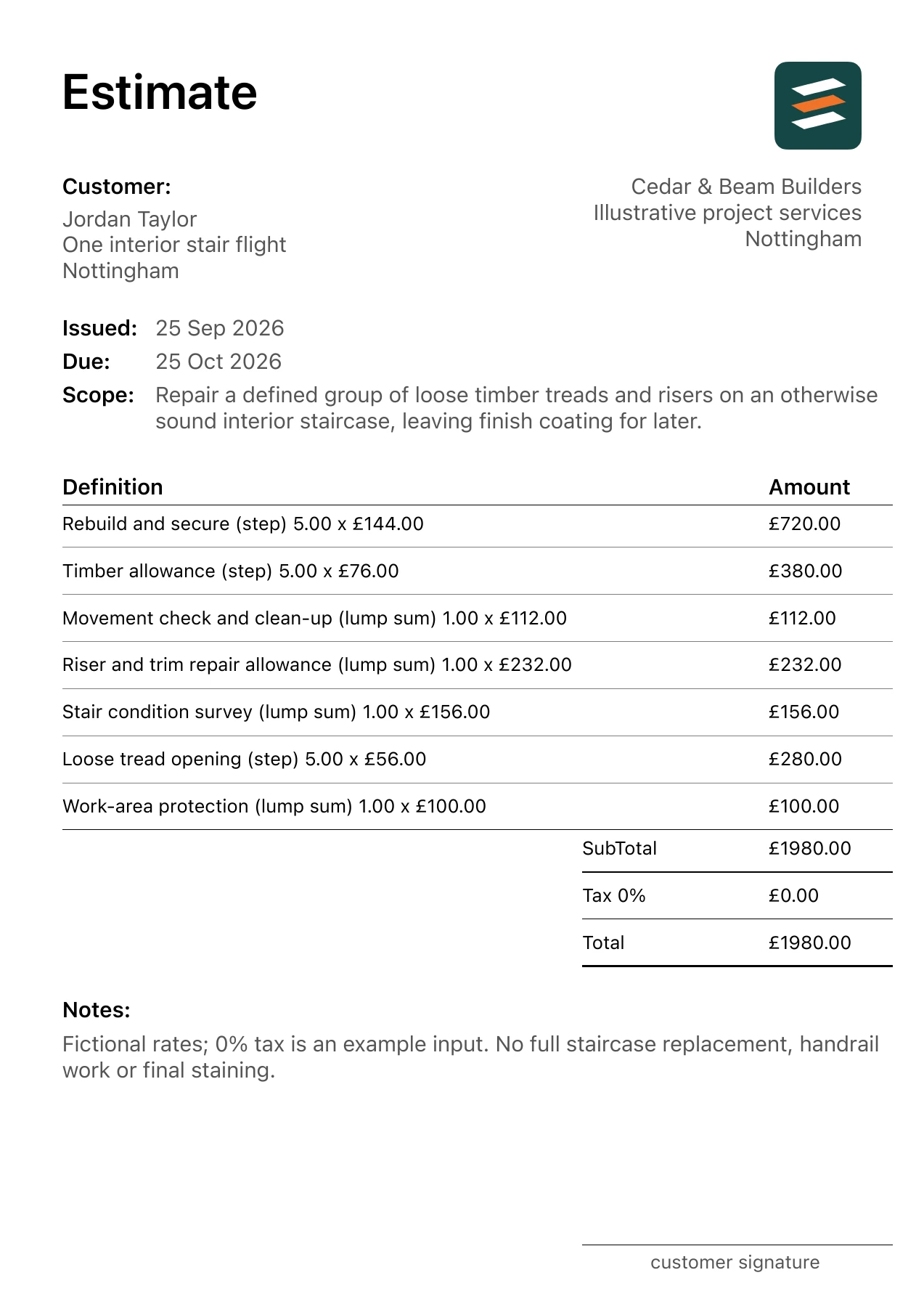
Estimate local timber staircase repair by measuring the defined one interior stair flight, separating product allowances from labour and setting out the work sequence and exclusions. This fictional Nottingham example uses 7 itemised lines totalling £1,980.00; its exact quantities and rates appear in the paired app PDF.
The worked job is one interior stair flight in Nottingham. The written scope is: Repair a defined group of loose timber treads and risers on an otherwise sound interior staircase, leaving finish coating for later. Its matching itemised example shows how that description becomes quantities, allowances and a PDF. These figures are fictional inputs for learning the method, so check the real site, specification and supplier or subcontractor costs before quoting.
1. Define the measured job
Repair a defined group of loose timber treads and risers on an otherwise sound interior staircase, leaving finish coating for later. Count affected steps, record movement, squeaks and accessible underside locations. Record the measurements and existing condition in the estimate before turning quantities into line items. The scope should make clear why this is a separate project from a broader renovation or maintenance quote.
Measure for this job: Count affected steps, record movement, squeaks and accessible underside locations. Record the measured basis next to the relevant cost lines, since a room count, fitted length and purchased product quantity may each use a different unit.
2. Build a product and labour schedule
Keep replacement timber, fasteners and adhesive as named allowances. This example has 7 distinct lines, including stair condition survey, work-area protection, loose tread opening. Use actual supplier prices and labour inputs for a customer job; the displayed amounts are fictional document inputs.
Choose before pricing: Keep replacement timber, fasteners and adhesive as named allowances. Keep a named allowance when the selection is open, and replace it once the actual product and delivery terms are known.
3. Sequence the work and handoffs
Confirm safe access and inspect the support after opening the first tread. Show which task depends on access, a selected product or another trade. If that dependency is still open, label the price preliminary and identify the information needed before a firm quote.
Plan the handoffs: Confirm safe access and inspect the support after opening the first tread. State which stage needs access or inspection before the next can begin, especially if a concealed condition might stop the work.
4. Set a change boundary
Failed stringers or widespread rot need a larger repair scope. The example excludes full staircase replacement, handrail work or final staining. Record the discovery, agree the revised work and update the estimate before adding it to the job.
Change trigger: Failed stringers or widespread rot need a larger repair scope. If this happens, write down the revised quantity and responsibility before adding an item to the customer estimate.
Worked project calculation
The paired PDF has 7 cost lines. For example, Loose tread opening is 5 steps × £56.00 = £280.00; Timber allowance is 5 steps × £76.00 = £380.00. Each amount is the stated quantity multiplied by its unit rate. Recheck whether a line describes installed work, a material purchase allowance or a distinct visit before changing its quantity.
| Work item | Quantity | Unit rate | Amount |
|---|---|---|---|
| Stair condition survey | 1 lump sum | £156.00 | £156.00 |
| Work-area protection | 1 lump sum | £100.00 | £100.00 |
| Loose tread opening | 5 steps | £56.00 | £280.00 |
| Timber allowance | 5 steps | £76.00 | £380.00 |
| Rebuild and secure | 5 steps | £144.00 | £720.00 |
| Riser and trim repair allowance | 1 lump sum | £232.00 | £232.00 |
| Movement check and clean-up | 1 lump sum | £112.00 | £112.00 |
| Illustrative total | £1,980.00 | ||
Adding the 7 exact line amounts gives £1,980.00. The PDF uses a 0% tax input and no markup solely to display this arithmetic. Decide the appropriate tax, overhead and profit treatment for an actual job; the fictional rates are not local averages or price recommendations.
Scope and price boundaries
Repair a defined group of loose timber treads and risers on an otherwise sound interior staircase, leaving finish coating for later.
Outside this example: No full staircase replacement, handrail work or final staining.
The role in this brief is carpentry contractor. Confirm who supplies the selected products, makes the site safe, removes waste and signs off the work. Where opening up reveals a different condition, document it and issue a revised scope and price rather than silently extending the base estimate. Also check access, drying or curing time, and the client handoff described in the work sequence.
Before you send
- Count affected steps, record movement, squeaks and accessible underside locations.
- Keep replacement timber, fasteners and adhesive as named allowances.
- Confirm safe access and inspect the support after opening the first tread.
- Failed stringers or widespread rot need a larger repair scope.
Compare the written scope with every line in the local timber staircase repair PDF example. The preview below is the first page of the actual app export; open the PDF to inspect its full scope, notes and amounts.
Questions about this job
Which quantity controls this local timber staircase repair estimate?
Count affected steps, record movement, squeaks and accessible underside locations.
When should this local timber staircase repair quote be revised?
Failed stringers or widespread rot need a larger repair scope. No full staircase replacement, handrail work or final staining.
FROM SITE NOTES TO AN ITEMISED PDF
Build your own local timber staircase repair estimate
Enter the project boundary and your measured lines in Estimates on iPhone or Android. Edit the fictional quantities and rates, add the actual business and client details, then inspect the PDF before sharing it.