THE ESTIMATING ANSWER
For one dwelling heat-pump system, start with a defined scope and measurement basis. Record conditioned zones, equipment locations, distribution condition, line route and power requirements. Keep equipment, controls, connection materials and commissioning separate. Price the listed tasks separately and state the condition that would require a revision: Inadequate distribution or supply capacity changes the equipment and ancillary scope.
This guide uses one dwelling heat-pump system as a worked, fictional job. Its matching itemized estimate and PDF let you trace the advice to actual document lines. The role considered here is mechanical contractor. Confirm the site conditions, product selections and your own costs before preparing a client quote.
1. Define the measured job
Install one selected central heat-pump system with a defined indoor and outdoor equipment arrangement after a qualified load and site assessment. Record conditioned zones, equipment locations, distribution condition, line route and power requirements. Record the measurements and existing condition in the estimate before turning quantities into line items. The scope should make clear why this is a separate project from a broader renovation or maintenance quote.
Measurement basis: Record conditioned zones, equipment locations, distribution condition, line route and power requirements.
2. Build a product and labor schedule
Keep equipment, controls, connection materials and commissioning separate. This example has 7 distinct lines, including load and site assessment allowance, outdoor unit allowance, indoor unit allowance. Use actual supplier prices and labor inputs for a customer job; the displayed amounts are fictional document inputs.
Selections to confirm: Keep equipment, controls, connection materials and commissioning separate.
3. Sequence the work and handoffs
A qualified designer must size the system; coordinate electrical and mechanical handoffs before installation. Show which task depends on access, a selected product or another trade. If that dependency is still open, label the price preliminary and identify the information needed before a firm quote.
Work sequence: A qualified designer must size the system; coordinate electrical and mechanical handoffs before installation.
4. Set a change boundary
Inadequate distribution or supply capacity changes the equipment and ancillary scope. The example excludes whole-building insulation retrofit, duct replacement or service upgrade. Record the discovery, agree the revised work and update the estimate before adding it to the job.
If the job changes: Inadequate distribution or supply capacity changes the equipment and ancillary scope.
Worked project calculation
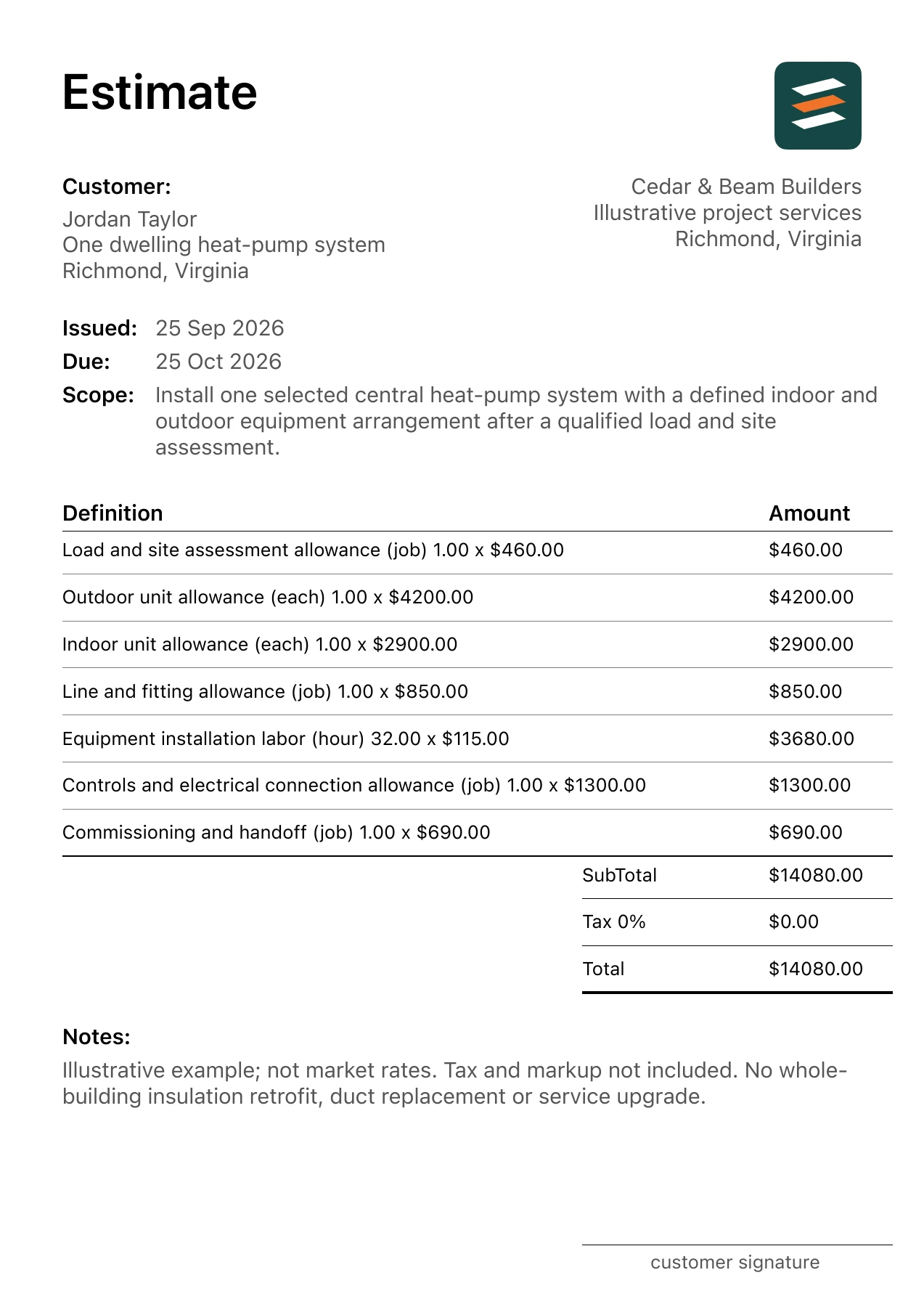
The example line for equipment installation labor is 32 hours × $115.00 = $3,680.00. This line is one part of the complete 7-item estimate and uses a fictional unit rate.
The paired estimate has 7 separate lines. For this fictional job, multiply each quantity by its unit price and add the line amounts to get $14,080.00. The sample PDF uses these exact values, with tax and markup left at zero so the arithmetic is visible. This total is an illustration, not a regional price or an offer to perform the work.
| Cost line | Quantity | Unit price | Line amount |
|---|---|---|---|
| Load and site assessment allowance | 1 job | $460.00 | $460.00 |
| Outdoor unit allowance | 1 each | $4,200.00 | $4,200.00 |
| Indoor unit allowance | 1 each | $2,900.00 | $2,900.00 |
| Line and fitting allowance | 1 job | $850.00 | $850.00 |
| Equipment installation labor | 32 hours | $115.00 | $3,680.00 |
| Controls and electrical connection allowance | 1 job | $1,300.00 | $1,300.00 |
| Commissioning and handoff | 1 job | $690.00 | $690.00 |
| Illustrative subtotal | $14,080.00 | ||
Scope and pricing boundaries
Install one selected central heat-pump system with a defined indoor and outdoor equipment arrangement after a qualified load and site assessment.
Outside this example: No whole-building insulation retrofit, duct replacement or service upgrade.
Separately identify supplier allowances, labor, subcontracted work and site-specific risk where they apply. Before giving a selling price, decide how your own overhead, profit and any applicable tax will be handled. Do not copy the fictional rates into a real quote without checking your own measurements and supplier or subcontractor figures.
Before you send the estimate
- Record conditioned zones, equipment locations, distribution condition, line route and power requirements.
- Keep equipment, controls, connection materials and commissioning separate.
- A qualified designer must size the system; coordinate electrical and mechanical handoffs before installation.
- Inadequate distribution or supply capacity changes the equipment and ancillary scope.
Read the complete central heat pump installation PDF example to see how the scope, individual prices and exclusions appear in a client-facing document. If a condition is still unknown, write that boundary into your estimate and revise the affected line once it is resolved.
Questions about this estimate
Which quantity controls this central heat pump installation estimate?
Record conditioned zones, equipment locations, distribution condition, line route and power requirements.
When should this central heat pump installation quote be revised?
Inadequate distribution or supply capacity changes the equipment and ancillary scope. No whole-building insulation retrofit, duct replacement or service upgrade.
TURN THIS EXAMPLE INTO YOUR OWN ESTIMATE
Build a central heat pump installation estimate for your project
Use Estimates on iPhone or Android to draft a scope with AI assistance or enter each line yourself. Review quantities, rates, exclusions, and client details before exporting a PDF. The example is free to inspect; some app features may require an in-app purchase.