THE ESTIMATING ANSWER
For eighteen doors and six drawers, start with a defined scope and measurement basis. Count fronts, exposed frame area and removable hardware; record the existing finish for adhesion preparation. Specify coating, colour, primer and whether new hardware is included as separate choices. Price the listed tasks separately and state the condition that would require a revision: Peeling laminate or oil contamination may require more preparation than the base allowance.
This guide follows eighteen doors and six drawers in Wollongong, New South Wales. The matching itemised estimate and PDF show how the job brief becomes measured quantities and separate AUD amounts. The responsible role in this scenario is painter. Check the actual site, selected products, supplier figures and labour plan before issuing a client quote.
How much paint do kitchen cabinets need? Measure the included faces
To calculate paint for kitchen cabinets, list doors, drawer fronts, frames and exposed end panels, then measure the faces included in the finish. State whether both sides of each door are painted and whether cabinet interiors are excluded. A count of doors is useful for handling work, but it is not a paintable-area calculation when their dimensions differ.
Calculate finish paint as agreed surface area multiplied by coat count, divided by the selected product's stated coverage. Keep primer and any different products separate. Record existing coating condition and request a suitable product and preparation assessment. A paint quantity calculator cannot decide compatibility, and extra coats should not be used as a substitute for defining the actual preparation and finish specification.
For the cost estimate, separate protection, preparation, finish work and agreed hardware handling. Record who removes and reinstates items when that is part of the contractor's scope, and identify any replacement handles as a separate selection. Compare quotes with the same faces and handoff condition; painting fronts only differs from including door backs, cabinet interiors and an extensive change of hardware.
A separate worked planning example
Independent illustrative arithmetic: an assumed 10 sq m of cabinet faces × 2 coats ÷ hypothetical coverage of 10 sq m per litre is 2 litres before rounding to available containers. This invented coverage is for arithmetic only. These hypothetical inputs are not market rates and do not replace the amounts in the linked PDF.
Cost and scope questions
How much paint do I need for kitchen cabinets?
Measure the included faces, multiply by the agreed coats and divide by the chosen paint’s actual coverage. Calculate primer separately and round purchases to container sizes.
Do cabinet painting estimates include the inside?
Only when explicitly stated. Door backs, cabinet interiors, end panels and hardware work should each be included or excluded in the written scope.
1. Define the measured job
Prepare and coat 18 kitchen cabinet doors and six drawer fronts, with frames finished in place. Existing boxes remain. Count fronts, exposed frame area and removable hardware; record the existing finish for adhesion preparation. Record the measurements and existing condition in the estimate before turning quantities into line items. The scope should make clear why this is a separate project from a broader renovation or maintenance quote.
Measure for this job: Count fronts, exposed frame area and removable hardware; record the existing finish for adhesion preparation. Put that measured basis beside the relevant PDF lines so area, fitted length and product purchase quantities stay distinct.
2. Build a product and labour schedule
Specify coating, colour, primer and whether new hardware is included as separate choices. This example has 7 distinct lines, including masking and door schedule, remove and label fronts, degrease and sand. Use actual supplier prices and labour inputs for a customer job; the displayed amounts are fictional document inputs.
Choose before pricing: Specify coating, colour, primer and whether new hardware is included as separate choices. The fixture separates masking and door schedule, remove and label fronts and degrease and sand rather than hiding all work in one figure.
3. Sequence the work and handoffs
Label each front before removal and plan off-site or staged curing before rehang. Show which task depends on access, a selected product or another trade. If that dependency is still open, label the price preliminary and identify the information needed before a firm quote.
Plan the handoffs: Label each front before removal and plan off-site or staged curing before rehang. Note which stage needs access, a selected product or another trade before the next stage can be priced confidently.
4. Set a change boundary
Peeling laminate or oil contamination may require more preparation than the base allowance. The example excludes cabinet replacement, internal box painting or benchtop changes. Record the discovery, agree the revised work and update the estimate before adding it to the job.
Change trigger: Peeling laminate or oil contamination may require more preparation than the base allowance. Record the revised task and quantity before it changes the amount your client sees.
Review the Australian job
Inspect the existing surface, access, product schedule and handoff conditions. Resolve unknown work and confirm any specialist requirements before giving a client a final quote.
The remove and label fronts line counts 24 each. Verify the actual locations and product schedule rather than carrying this fictional count into another property. The amounts are fictional AUD inputs, not current prices for Wollongong, New South Wales or another location.
Worked project calculation
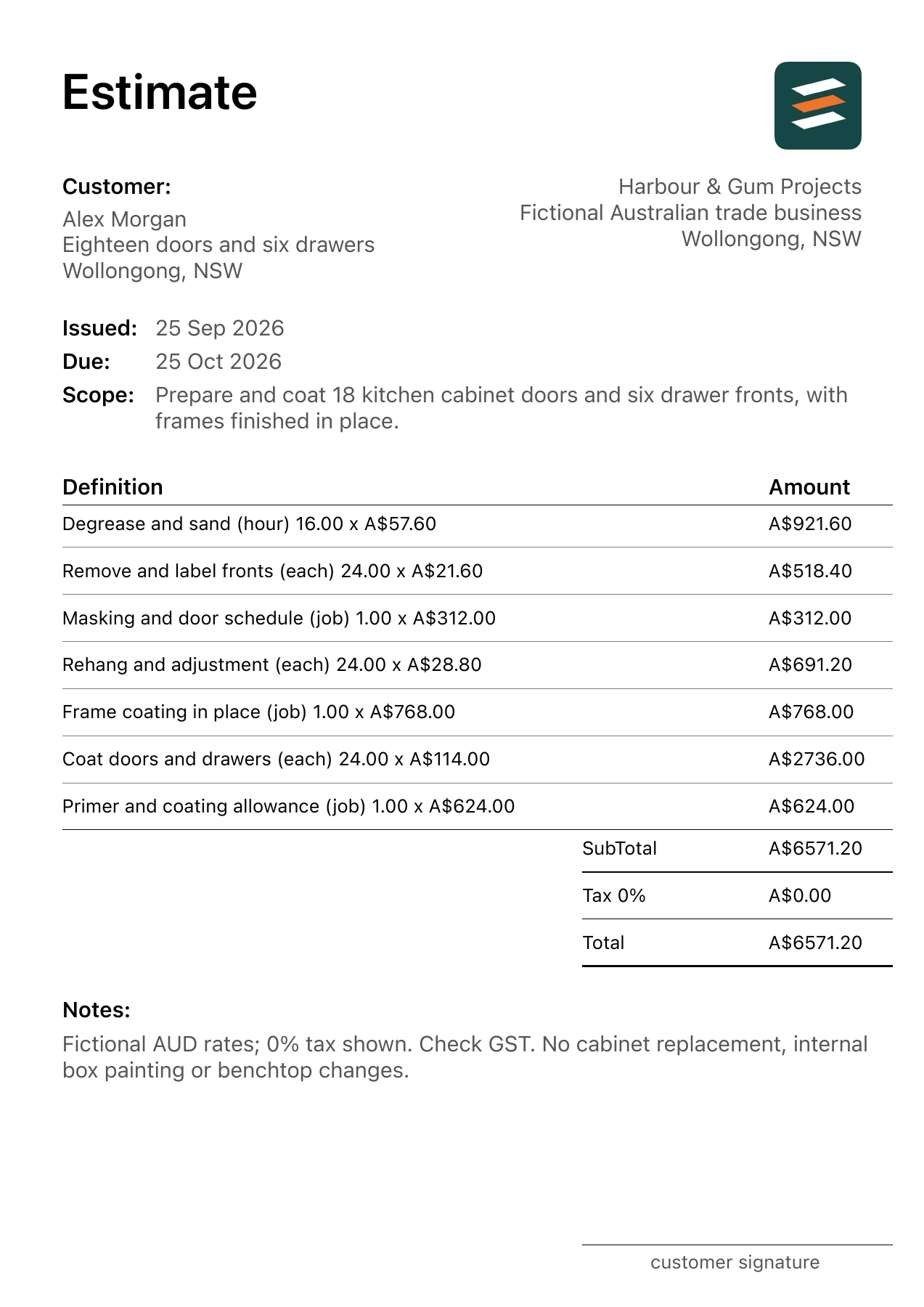
The paired PDF has 7 cost lines. For example, Remove and label fronts is 24 each × A$21.60 = A$518.40; Degrease and sand is 16 hours × A$57.60 = A$921.60. Each amount comes from the stated quantity and unit rate, so you can trace the arithmetic back to the job scope.
| Work item | Quantity | Unit rate | Amount |
|---|---|---|---|
| Masking and door schedule | 1 job | A$312.00 | A$312.00 |
| Remove and label fronts | 24 each | A$21.60 | A$518.40 |
| Degrease and sand | 16 hours | A$57.60 | A$921.60 |
| Primer and coating allowance | 1 job | A$624.00 | A$624.00 |
| Coat doors and drawers | 24 each | A$114.00 | A$2,736.00 |
| Frame coating in place | 1 job | A$768.00 | A$768.00 |
| Rehang and adjustment | 24 each | A$28.80 | A$691.20 |
| Illustrative total | A$6,571.20 | ||
Adding every exact-cent line gives A$6,571.20. The PDF uses a 0% tax input only to make its fictional arithmetic visible. Confirm the GST treatment that applies to the actual job and set your own markup before sharing a client quote. A fictional rate is a document input, not a market quote or a recommended selling price.
Scope and pricing boundaries
Prepare and coat 18 kitchen cabinet doors and six drawer fronts, with frames finished in place. Existing boxes remain.
Outside this example: No cabinet replacement, internal box painting or benchtop changes.
Separate product allowances, supply, installation, disposal and any specialist work where the actual project needs them. If access or a hidden condition changes, document the affected scope and agree a revised price instead of silently extending the base amount.
Before you send the estimate
- Count fronts, exposed frame area and removable hardware; record the existing finish for adhesion preparation.
- Specify coating, colour, primer and whether new hardware is included as separate choices.
- Label each front before removal and plan off-site or staged curing before rehang.
- Peeling laminate or oil contamination may require more preparation than the base allowance.
Check business and client details, address, dates, scope, units, line amounts and PDF notes. The kitchen cabinet painting PDF example shows how this fictional project is presented. Its short PDF note is not a substitute for the detailed exclusions above.
Questions about this estimate
Which quantity controls this kitchen cabinet painting estimate?
Count fronts, exposed frame area and removable hardware; record the existing finish for adhesion preparation.
When should this kitchen cabinet painting quote be revised?
Peeling laminate or oil contamination may require more preparation than the base allowance. No cabinet replacement, internal box painting or benchtop changes.
TURN THE SCOPE INTO AN ITEMISED PDF
Make your own kitchen cabinet painting estimate.
Describe the actual job in Estimates on iPhone or Android or use AI assistance to start a draft. Check every measurement, quantity, rate, allowance, client detail and note before exporting your PDF. Some app features may require an in-app purchase.