EXAMPLE AT A GLANCE
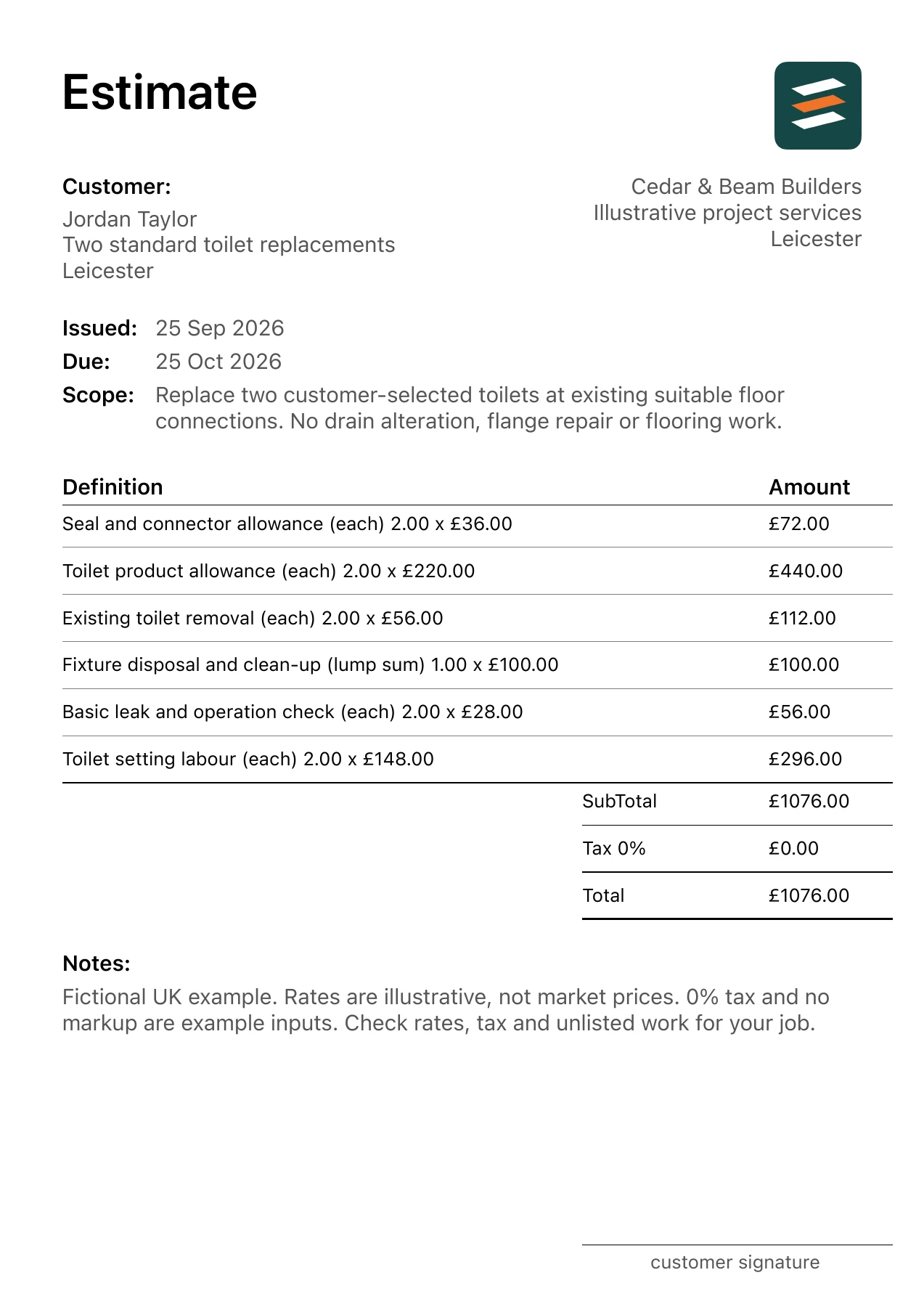
This Leicester example prices two standard toilet replacements with 6 itemised lines and a £1,076.00 illustrative total. It uses fictional prices, a 0% tax input and no markup; verify all inputs for an actual job.
A defined toilet replacement job
This fictional project is located in Leicester. Replace two customer-selected toilets at existing suitable floor connections. Include fixture allowance, removal, new seals and supply connectors, setting, basic leak check and disposal. No drain alteration, flange repair or flooring work. The written scope is the boundary of the example: a customer should be able to match each planned task to a line in the document, and see where a product choice or hidden condition still needs checking.
- Prepared by
- Cedar & Beam Builders · fictional business
- Prepared for
- Jordan Taylor · fictional customer
- Example location
- Leicester, UK
- Issued / valid through
- 25 September 2026 / 25 October 2026
Read every amount in pounds
The table reproduces the fixture sent to the app exporter. Each amount is its quantity multiplied by the shown unit rate, rounded to pence. The largest line is Toilet product allowance at £440.00; that is a part of the total, not a standard price for work of this kind. Check the unit, quantity and scope together before comparing lines with a real supplier or subcontractor quote.
| Work item | Quantity | Unit rate | Amount |
|---|---|---|---|
| Existing toilet removal | 2 each | £56.00 | £112.00 |
| Toilet product allowance | 2 each | £220.00 | £440.00 |
| Seal and connector allowance | 2 each | £36.00 | £72.00 |
| Toilet setting labour | 2 each | £148.00 | £296.00 |
| Basic leak and operation check | 2 each | £28.00 | £56.00 |
| Fixture disposal and clean-up | 1 lump sum | £100.00 | £100.00 |
| Subtotal / example total | £1,076.00 | ||
For a quick cross-check, existing toilet removal is 2 each × £56.00 = £112.00, and toilet product allowance is 2 each × £220.00 = £440.00. The sum of all 6 line amounts is £1,076.00. The PDF's 0% tax input and zero markup are example settings; determine the correct inputs for your own work.
What this example assumes
Note floor condition and any visible movement or leakage. The sample assumes suitable existing connections; unknown flange or subfloor repairs are a separate review point.
Work outside the example: No flange replacement, drain repair, subfloor or flooring repair, fixture relocation or concealed plumbing work.
The quantity basis matters. Where a product allowance differs from an installation quantity, the difference reflects this fictional layout or purchase plan and must be checked against the selected product. Existing conditions, safe access and any necessary approvals remain project decisions. Agree how changed measurements or discoveries will be recorded and priced before extra work begins.
View the app-exported PDF
The PDF was generated from this fictional project, with the exact line items, dates, customer and business details stated here. It is a completed example document for learning how an itemised estimate reads. Its prices are illustrative and are not current Leicester market rates.
Build an estimate for your own job
Start with a measured site record and the customer's selected finish or equipment. Replace all fictional quantities and rates, assign responsibility for supply and waste removal, and check that the exclusions describe the actual boundary. Review each extended amount, total and note in the PDF before sharing it.
- List each bathroom and selected product.
- Confirm existing connection assumptions.
- Assign purchase and disposal responsibilities.
- Document how discovered repairs are authorized.
Read the matching toilet replacement estimating guide for the measurement and scope decisions behind the example.
Common questions
Should the toilet product be a separate line?
Yes when the selection may change. A separate allowance shows the product cost and leaves installation labour clear.
What if the flange is damaged?
Treat it as a changed condition: document the required repair and revise the scope and price before proceeding.