THE SHORT ANSWER
An interior demolition estimate should name exactly what is removed, what remains and how debris is handled. Separate finish removal from structural or service-system work, and resolve unknown materials and utilities before work is authorized.
The worked project in this guide is nonstructural finish removal. It uses an original fictional job to explain the estimating decisions, with a matching interior demolition PDF example. Replace the example inputs with your measurements, supplier quotes and labor costs.
Demolition estimating formula: quantities, handling and assessed exclusions
An interior demolition estimate should identify each item removed and each surface or system retained. Measure removable finish area, count discrete fixtures and record the route for taking waste out of the building. Keep these units visible instead of converting the entire project into one demolition rate. The scope needs an assessed boundary before any formula can produce a useful total.
Use quantity multiplied by the agreed task rate for each defined removal line, then add separately assessed protection, handling and disposal. Distinguish removal labor from waste volume and transport; intact material volume is not automatically the loaded waste quantity. Obtain specialist review for structural elements, services and suspect hazardous materials, and keep them outside ordinary finish demolition until responsibilities and required assessments are confirmed.
For comparable demolition calculations, give bidders the same removal schedule and access assumptions. State who makes the relevant systems safe, which areas remain occupied and how discoveries change the quote. A calculator cannot authorize work or prove that a wall is safe to remove. Record unresolved matters as a hold point for assessment rather than disguising them inside a general contingency or waste allowance.
A separate worked planning example
Independent illustrative arithmetic: an assumed 200 sq. ft. finish-removal line at $1.00 per sq. ft. gives $200.00. Invented protection of $50.00 and agreed waste handling of $100.00 bring these defined lines to $350.00. These hypothetical inputs are not market rates and do not replace the amounts in the linked PDF.
Cost and scope questions
What is the demolition estimating formula?
For defined work, sum each quantity × task rate and add separate protection, handling and disposal lines. Establish assessed exclusions before using the total.
Can floor area predict demolition waste volume?
Not reliably by itself. Identify materials and measured dimensions, then confirm the waste and loading assumptions with the responsible contractor.
1. Define the removal boundary
List surfaces and components by location and quantity. Mark retained cabinets, walls, fixtures and finishes. Clear boundaries help prevent a removal estimate from being mistaken for authorization to strip an entire room.
2. Resolve prerequisites before pricing certainty
Identify any assessment, service isolation or material testing required for the actual job. Do not assume concealed conditions are safe or included. This example prices defined finish removal only and is not a procedure for carrying out demolition.
3. Estimate handling as well as removal
Debris must be moved through the property, loaded and disposed of. Record the access path, stairs and storage constraints. The sample includes a disposal allowance, but actual fees and arrangements should come from the relevant provider for the material involved.
4. Describe the handoff condition
Broom-clean, ready for inspection and ready for new finishes are different outcomes. Explain what cleanup includes and whether surface repair follows removal. Keep reconstruction in a separate estimate or clearly separated work section.
A worked interior demolition calculation
Floor removal is 300 sq. ft. × $1.25 = $375. Wall-board removal is 200 × $1.50 = $300. The combined $675 does not include the separately stated debris-handling allowance.
The complete example contains 6 lines totaling $1,850.00 before any tax or markup. These are deliberately stated example prices, not a survey, regional price recommendation or offer to perform the job.
To set your own selling price, review direct costs and decide how you will cover overhead and profit. For example, adding 20% to a $1,000 cost gives $1,200; it does not produce a 20% gross margin. Use the approach you intend consistently, and avoid adding a second markup to rates that already include it.
Before you send the estimate
- Identify retained and removed components.
- Confirm prerequisite assessments and service arrangements.
- Record debris access and disposal assumptions.
- Define cleanup and reconstruction boundaries.
Example scope boundary: No structural demolition, utility disconnection, hazardous-material abatement, concealed-condition repairs or reconstruction.
Review the client name, location, validity date and all calculations. Tax is not included in this example; determine the correct treatment for the actual work rather than copying a sample percentage.
Common questions
Does a demolition estimate include rebuilding?
Not unless rebuilding is explicitly listed. Separate removal, cleanup and reconstruction so the customer understands the condition left at the end of each scope.
Why show debris handling separately?
Removal effort and disposal arrangements can change independently. A defined handling line makes access constraints and provider charges easier to review.
TAKE THE NEXT JOB FROM SCOPE TO PDF
Make your own interior demolition estimate.
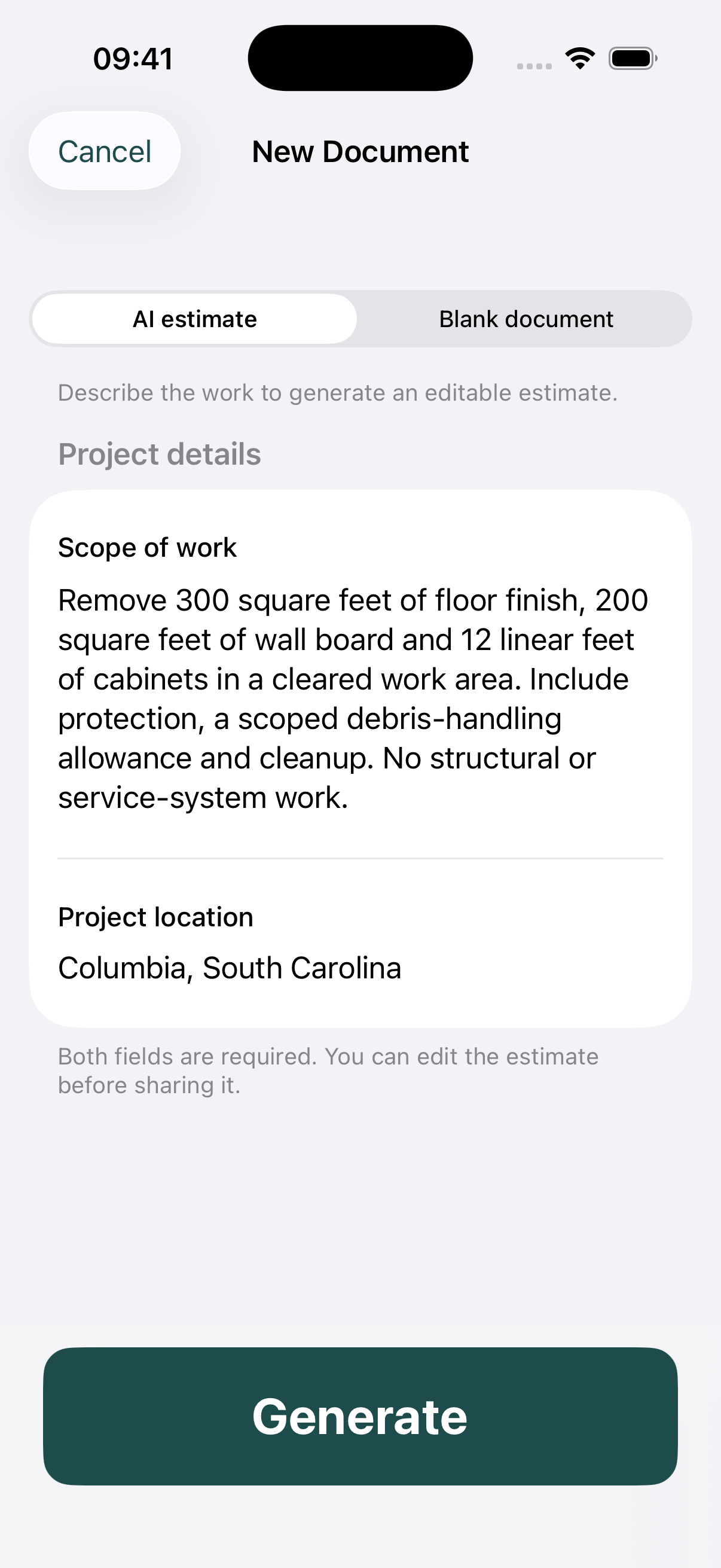
Use Estimates on iPhone or Android to draft a scope with AI assistance or enter your own items. Review quantities and rates, add your business logo, and export a PDF. Example files are free to view; app features may require an in-app purchase.